Showing posts with label 3G. Show all posts

Friday, September 4, 2015

More On Those Dropped Calls


A basic problem is that the cost of spectrum and licences relative to earnings is too high, structurally.

Shyam Ponappa   |  September 3, 2015


Will the government's variant of "speak softly and carry a big stick" deliver Digital India in a hurry? Unlikely, because the problem is an overloaded system with a too-spare design, and insufficient cash flows. Increasing call drops are a symptom of inadequate carrying capacity for the demands of traffic, from voice to data in 3Gand 4G. These are structural problems, because the system doesn't generate sufficient investible funds; nor are conditions right to develop such investment capacity; nor are the prospects demonstrably healthy. The situation requires the policy changes outlined below, which only the government can bring about, as it has in the past.

A fundamental aspect of the problem is low spectrum availability. India's operators have 12-15 MHz, compared with a global average of 45-50 MHz. Leading countries have even more; for instance, operators in Seoul reportedly have 10 times more spectrum than operators in India. Limiting the spectrum available to operators compels them to invest more to deliver a given level of traffic and quality than if more spectrum were available.

There are other aspects as well:
  • high charges for licences and for spectrum, 8+4 per cent of (adjusted) revenues in addition to auction payments,
     
  • imported equipment paid for with a weak stream of local-currency revenues,
     
  • changes in spectrum holdings that require adjustment in equipment after older spectrum assignments lapse and new spectrum has been acquired, and
     
  • the burgeoning need for new investments for 3G and 4Gservices. Embedded in the latter is the additional overload caused by tower shut-downs and the difficulties in getting additional sites, apart from the need for more capital.
Add regulations that hinder spectrum trading and sharing, and we have a sector that is structurally weak and restricted in scope.

As for call drops, operators in developed markets experienced similar capacity pressures when there was very rapid growth in data usage, for instance AT&T in the USand O2 in the UK some years ago. The difference is that they were able to invest rapidly to shore up their networks. By contrast, Indian operators had to invest disproportionately in acquiring spectrum, leaving less capacity for investment in networks. For example, in 2014 operators in China reportedly invested $35 billion in 4G equipment, whereas in India, only $3 billion went into equipment. Most of its $32-billion investment - $29 billion, over 90 per cent - was for spectrum. There has also been the diversionary effect because difficult business conditions in the sector led to profits being invested elsewhere, instead of back into communications infrastructure. The difference in approach and functional capacity is stark: China is moving ahead with building high-speed data capability, while the struggle in India is with dropped calls and simply keeping users connected. The government, therefore, needs to facilitate conditions whereby operators invest substantial amounts every year.

For this to happen, the structure of high charges for spectrum and licences relative to earnings has to change, as do restrictive regulations. The monthly average revenue per user in India at the end of 2014 was of the order of Rs 110-120. Capital expenditure ranged from 13 to 15 per cent of revenues in 2014, rising to 20 per cent in 2015. The latter exceeds the percentage invested in the US - but the revenue in India is about 25 times less than the $50 revenue in America, and the US has had well-developed networks for decades. Meanwhile, the recent spectrum-sharing guidelines that restrict more than enable effective sharing epitomise our dysfunctional regulations.
 It is baffling why the government would issue such retrograde regulation if the goal is digital development, because these guidelines do exactly the opposite of what is needed.

Government versus Private Sector


Meanwhile, there has been an escalating war of words between the government and service providers. The latter are trapped in a vicious circle of heavy investment requirement with low revenue-generation capacity, as explained above. Breaking out of this trap is possible only if the government develops conducive policies, as it did with the path-breaking changes associated with the 1999 New Telecom Policy (NTP-99). The change at that time was from up-front licence fees to revenue-sharing. It fell short because the government's share was too high, and began to work only after 2003, when government charges were reduced. In like manner, the government needs to frame policies applying similar principles to spectrum, and ultimately to network infrastructure, so spectrum and networks become more productive.

Our problems arise from three sources: regulations and government charges, operator behaviour and responses, and public opinion and the perceptions and actions of the judiciary. The government can take the initiative through creating policies that facilitate investment and service delivery. Many changes are purely administrative, such as permitting unrestricted spectrum sharing without additional "conversion" charges, or reducing licence and spectrum charges. Surely the department of telecommunications, the finance ministry, and the prime minister's office understand the logic of higher net present values that accrue from incremental revenues to operators. Conversely, any restriction of revenues or opportunity loss reduces the government's share, resulting in lower net present values. For example, restricting 3G roaming or insisting on payments to convert administered spectrum before it can be shared limit revenues, resulting in opportunity losses.

The government needs to be persuasive while acting decisively, to influence operators and public opinion through well-formulated systematic initiatives. Tighter monitoring of quality, including dropped calls, and related penalties are needed - but balanced with constructive policies. These could cover enabling regulations such as for roaming and secondary spectrum sharing with the government, and in developing a consortium approach for active network sharing initiated by the government with broad private participation, led by a private-sector partner. Other potential areas include enabling, organising, and facilitating broadband through cable networks, and inducting technologies such as TV White Space and satellites.

This is where the rhetoric of leading Team India has to be walked and not just talked, to persuade and lead the sector to collaborate and not undercut institutional development.


Shyam no-space Ponappa at gmail dot com

1 E.g., see https://www.linkedin.com/pulse/sharing-spectrum-operators-steeplechase-parag-kar


Comments

JAHAR

The huge bids while acquiring spectrum at the auctions held recently were bound to impact operator's short run cash flow and investment capability. This in turn impacts network management and up-gradation at least in the short run. No amount of dictats will change this

ASHOK

Would it be over dramartic to say that call drops are the gasps of an industry that is drowning in something other than windfall profits ! Indian businessmen are not saints, true, but they need a more sympathetic hearing in the government's court. If the Savile Row types are in distress, what will happen to the rest of us ?

MANOJ

Nice article, and good points about institutionalizing, not just doing jugaad. However, the point about equipment is not valid, falling capacity costs are the main reason telecoms are able to deliver such good service in India. (not customer support). Call drops are far lower in India than many far richer countries in the world. Some leading operators in UK & US both have much higher incidences of call drops. Instead of absolutism, the government should link the maximum charges leviable by the operator to Quality of Service, and let the operators decide how they are going to distribute their services.


Friday, November 7, 2014

(Fixing) India's Systemic Flaws


We need breakthroughs in tax claims and coal and spectrum allocation, but most of all, in societal accord


On the face of it, several developments augur well for the economy. But major systemic flaws persist that must be overcome.

Some gains have resulted from Prime Minister Narendra Modi's direct selling and "heavy lifting", as in eliciting Japanese investments. Others, such as the drop in petroleum and commodity prices, are attributable to extraneous factors. The positive developments that seem to be coalescing into a glow on the economic horizon include:
  • The revival of stalled projects.
     
  • A reduction in raw material costs, with oil prices now well under $90 a barrel.
     
  • Significant investments from Japan's SoftBank in Snapdeal and Ola; other significant investments and announcements in e-commerce, for example, Flipkart and Amazon.
     
  • The implementation of electronic toll collection (ETC) on our highways. Introduced between Ahmedabad and Vadodara on National Highway 8 (NH-8) in 2013, the ETC became available last week between Delhi and Mumbai on NH-8. It is expected to be available on all national highways in the next two months. Vehicles with prepaid tags can drive through without slowing down, whereas until now, all vehicles had to stop to pay tolls. The productivity gains will be enormous, with fuel savings across toll stations estimated at Rs 60,000 crore (see BS, October 30, 2014 and BS, October 31, 2014 for details).

But all is not entirely well. The fiscal deficit is at 80 per cent of what was budgeted for the full year; there was a decline in projects completed in the September quarter; and there is uncertainty about growth rates.

The real issue, though, is that major systemic flaws persist, resulting in growing economic and operating constraints. There are the problems of retrospective tax claims, of coal allocation and of spectrum allocation. In the societal dimension, there are continuing indications of disharmony, resulting in wariness and insecurity about whether we have a unifying or divisive top leadership, let alone rank and file. Proceeding with business as usual with the present ineffective ways will lead to continuing and increasingly overwhelming detrimental effects. Each of these areas needs breakthroughs to achieve convergent, synergistic results.

Coal

Over 60 per cent of stalled projects tracked by the Performance Management Group in the Cabinet secretariat are power projects, held up because coal is not available. Coal-mining rights are to be auctioned on the lines of spectrum. What are the likely outcomes?

While the government was jubilant about funds collected from the auctions, this created enormous capital and operating constraints for the communications sector. This is because the Rs 1.05 lakh crore bid for spectrum became unavailable for network construction and operations, and the limited bandwidth available to each operator adds to costs and restricts delivery capability. Growth in network capacity has deteriorated to the point where we have higher levels of dropped calls in metros, with continuing poor broadband access countrywide. The effects on productivity are ruinous.

What can we expect from mining rights auctions? If the results are as for the spectrum auctions, we'll have high treasury collections, high life-cycle project costs affecting critical inputs like electricity, steel and aluminium, and a reduction in investment in mining operations and downstream manufacturing. These are logical outcomes: the consequence of higher costs is either higher prices, or financial under-recovery leading to collapse, and capital used for auctions is unavailable for investment. Instead, what we really want from the mining allocation is inexpensive electricity and efficient production of industrial materials, such as steel and aluminium.

The financial insolvency of our state electricity boards reflects the magnitude of the problem. Even the story of Gujarat's electricity distribution raises questions for the rest: Gujarat's average farm tariff is under Rs 1 a unit, compared with a non-farm tariff of Rs 4-5 (see "Farmers pay 56 paise per unit of electricity"*). The high cost of providing these connections is unviable with the low revenue of 56 paise a unit. This is why there is a backlog of about 400,000 farmers waiting for connections despite Gujarat's "surplus" of over 2,000 megawatts. Distributing electricity at such low rates is simply unsustainable, and the situation is much worse in states providing free electricity.

A possible way to approach this is to appoint two or three individuals with the integrity and competence to work with the government, industry and experts to develop an allocation plan. If this "beauty-parade" approach seems too utopian or academic for India, please be aware that this is precisely how land acquisition was actually done for the Calcutta Metro around 1982 after years of delay, and for part of the Bangalore Metro in 2006.

Spectrum

The spectrum constraints, meanwhile, show in the high levels of dropped calls because of congested lines, and the slow rollout of networks into rural areas. This slowness is because of the unfavourable economics: of high cost and difficult execution, with lower revenue potential. What we want from spectrum allocation is access to broadband networks at prices that will result in productivity gains. Instead, we have neither adequate broadband networks, nor sufficiently widespread access for productivity. A better solution is pooled networks with mandatory shared access on payment, with the government getting a share of revenues.

Ecosystems

Apart from inadequate infrastructure, logistics, finance and regulations, all of which must be well-orchestrated to achieve supportive ecosystems for investment and operations, the tax-claims fallout continues to undermine growth prospects. While the Vodafone problem may be finally resolved, the closure of Nokia's manufacturing facility in Chennai because of tax claims undercuts all the sales talk. Each sector needs a supportive ecosystem, integrated with the rest.

Social Disharmony

Above all, social disharmony seriously affects our capacity for collective action. Social coherence is essential for constructive development. The leadership's effectiveness in reaching out and inspiring constructive aspirations can help to harmonise and channel citizens towards desirable common goals. Such collective initiatives would reduce our fractiousness and infighting, making win-win outcomes more possible.

The solutions in all these areas need to be path-breaking, based on integrity, trust and bold, collaborative action. We have to learn these ways.


                                                                              Shyam (nospace) Ponappa at gmail dot com

*http://indianexpress.com/article/cities/ahmedabad/farmers-pay-56-paise-per-unit-of-electricity/

Comments (2):

  • karthikeyan
    Tax Havens can be created , for NOKIA alikes ?? :)
  • ashok
    The state of the power sector can make or break Make In India. Worthy of attention at the highest levels of government. 2. Whether spectrum or coal, the government can meet the industry half way by taking its entitlement as a revenue stream rather than an initial lump of capital.


Friday, August 8, 2014

Transformation, or Drift?

We need transformative policies and incentives with purpose, especially in solar power and digital infrastructure.

Shyam Ponappa   |   

An uneasy sense of drift has set in after the anticipation that accompanied the swearing-in of the National Democratic Alliance government. Surely, the government understands that its real task is to build on hopes and expectations, to channel energies, to organise and coordinate for results, even perhaps try bipartisan teams? The opportunity is to overcome factionalism and harness people's energies, instead of floundering in disunity. We need transformative policies, programmes and with purpose.

Resolute efforts in specific sectors can change this sense of the same old same-old. Two aspects of infrastructure that need early attention are: first, solar power, and second,(see "A great start by Modi government", June 5, Business Standard).

Solar power, critically important in its own right, is essential for digital infrastructure because of the poor grid supply. Disappointingly, the steps taken are more of the same. For instance, the renewal of the national solar mission. for an increased 1,500 megawatts, is on the same lines as before - that is, a 30 per cent subsidy for solar farms, accelerated depreciation and (RECs) that provide subsidies for a fixed period. While the target is higher, it is minuscule compared to the potential, and relative to other energy sources. For distributed user installations, interest-free loans seem ineffectual, because the high prices are unchanged, although payable in instalments - hardly ground-breaking.

Could the government try a more radical incentive of zero tax on equipment in addition to a 30 per cent subsidy, with immediate reimbursement and stiff penalties for misuse? Lower capital costs would probably induce much more extensive deployment, spurring manufacturing and innovation through sheer volume. This is likely for solar farms as well, and these incentives could be made available if such farms are really desirable. The government would lose upfront taxes on equipment, but avoid the cost and complexities of the and accelerated depreciation, while gaining taxes downstream from increased productivity.

Similarly, in communications, we need countrywide access to broadband at reasonable prices. Users could benefit from applications such as education at all levels, from secondary school to college to continuing education for adults, healthcare; e-commerce; remote working/telecommuting; government services, information; and entertainment. Of course, once we have broadband, we'd need the range of useful, attractive content and services that result in improved user satisfaction, as well as productivity. These "supplementary effects" will undoubtedly take time to develop and play out, but the prerequisite is the access.

On this score, the much-awaited spectrum sharing recommendations are sorely disappointing. Their intent is puzzling because they are so restrictive, limiting sharing to two operators who have acquired frequencies in the same band in the same manner, with a cap of 50 per cent.

Build and Run Communications Networks Like Roads

Perhaps the telecom regulator's recommendations on spectrum sharing are an opening gambit to explore active network sharing. The logic for network and spectrum sharing is compelling. With India's self-created spectrum constraints and genuine deficiencies of capital and network coverage, the rational approach for our developing economy would be to optimise their use, as with roads. For this, active network sharing, including radio access networks and spectrum, is the most efficient solution, as is the case for roads.

Unfortunately, our policies are at the other extreme, of spectrum auctions and exclusive networks. This is least efficient for extending underdeveloped infrastructure services, as building and operating multiple exclusive networks requires the most resources, including capital. Auctions may be a reasonable alternative where there's existing infrastructure, and the issue is of allocating resources to whoever can make the best use of them. In our situation and given our needs, the way we build and operate roads may be a better alternative to achieve coverage.

To see why, compare the contrasting approaches of building communications networks with highways and roads. Road developers not only don't have to pay auction fees for the right to build roads, they are paid periodically for the construction of the assets. Ownership of the assets is then transferred to the state or other agency, and all road tax and toll payers may use the facilities. Similarly, all licensed operators could have access to communications networks on payment. While payback periods are often longer for roads, the nature of the financial flows are the same: capital must be invested in building the network before revenues are generated from users. People need to be informed and educated about this inescapable process.

Sparsely populated rural areas have lower revenue potential than urban areas. Hence, communications networks and services in rural areas lag because of commercial considerations. This deprivation is aggravated by front-loading auction fees for spectrum, which curtails investments in the networks and services in areas with lower potential. Also, unless operators pool resources, exclusive usage militates against full utilisation of the infrastructure. Our policies should reflect all this, instead of restricting spectrum access and sharing, including for 3G.

The real irony is that the pay-for-use principle is well accepted for roads; yet the opposite principle of auctions is used for communications networks. This is the unintended consequence of accepting auctions without thinking through what we need in our circumstances compared with advanced economies, and how to achieve those objectives.

Our spectrum policies have resulted in small bands of non-contiguous spectrum holdings that severely restrict capacity. Besides, operators have to invest heavily simply to protect the assets built. Yet countrywide broadband services need more spectrum to be used much more effectively to facilitate last-mile access. The kind of solution we need is for all remaining spectrum to be used for a common-access network, owned by a consortium of operators, including state-owned Bharat Sanchar Nigam and Mahanagar Telephone Nigam as "anchors". Once integrated with existing networks, operators can commercially deploy services with enhanced capacity, for which they pay as they use, and get paid. Broadband can be revolutionised by setting this up and converting spectrum fees to pure revenue sharing, as happened for mobile telephony with licence fees years ago. With the benefit of hindsight, the fees can be set low from the start, with regulatory oversight to avoid predatory pricing, and growth will most likely explode.


Shyam nospace Ponappa at gmail dot com

Thursday, April 5, 2012

China 3: Build Comprehensive Ecosystems

Failures in electricity, transport and broadband have common strands. China's approach offers a possible alternative

Shyam Ponappa / Apr 05, 2012

India’s inability to address infrastructure is legendary, barring historical exceptions. It shows in electricity shortages, inadequate sanitation, broadband, railway services, airlines and roads. This explores the common strands of such failures, and a possible alternative drawing on China’s approach to development.

Electricity shortages are attributed to a tangle of factors: difficulties with fuel supply – for instance, for coal, there are problems in mining, and unrelated problems in transport, including the limitations of the railways – or the difficulties with nuclear and hydroelectric power development faced with overzealous activism, aggravated by the government’s poor record of compensation to affected people; unsustainable populist pricing; a lack of integrated planning (for example, generation capacity without linkages to fuel); and poor execution.

In transportation, there’s another tangle in the railways, with populism and deteriorating finances, yet making plans for super-fast trains. Airlines are treated as either a milch cow for government revenues or a sacred cow when it comes to providing endless, unviable subsidies.

Consider, also, spectrum and broadband. After mobile telephony’s meteoric rise, prospects of growth with pervasive broadband are receding, with little indication of supportive policies from the erstwhile New Telecom Policy, or NTP-2011, now NTP-2012-if-we’re-lucky. The episodic pronouncements and actions have been retrograde, such as the “tax attack” on Vodafone after the Supreme Court dismissed earlier tax claims, or the withholding of Qualcomm’s spectrum until recently. Worse, there’s an apparent pincer movement undercutting 3G by prohibiting roaming, while announcing spectrum auctions with hardly any spectrum available. Defence spectrum release has stalled, as Bharat Sanchar Nigam Limited has not built the alternative fibre optic network. Consequently, the department of telecommunications has only 150 megahertz of spectrum for commercial use, of which only 5 MHz remain for 3G. Combined with the prohibition on roaming, this effectively stymies 3G.

There’s more pressure on GSM operators coming up to “refarm” the 900 MHz spectrum when licences are renewed from 2014 to 2016. The best solution for incumbents as well as others without bandwidth below 1 gigahertz is to share networks. This would seem an obvious solution for 3G as well, and might even trigger or revive other technologies because spectrum is available, just as the dearth of spectrum may contribute to the untimely exit of WiMAX (802.16) or iBurst (802.20).

However, restrictions on roaming and insistence on spectrum auctions will ensure that spectrum sharing is either impractical or legally infeasible. This means India will deny itself the benefits of developments in spectrum sharing in TV white spaces in the US and in the UK, including its possible extension to other bands.

Comprehensive Ecosystems

Systematic plans to cripple our electricity, airlines, or telecommunications sectors could not do worse. Is there a way to break out of this downward vortex?  There could be, if the government took a problem-solving rather than a revenue-seeking approach, and sought to develop comprehensive, integrated ecosystems over a reasonable period.

Consider China’s approach to information and communications technology, epitomised by Huawei’s iconic position today. It is comprehensive, thorough and integrated, with the goal of significant scale and dominance. It covers the complete ecosystem, starting with education and training. Technology is a thrust area for economic growth, with many large universities, encouragement for graduate studies abroad, incentives for the diaspora to return, opportunities and support for faculty entrepreneurship, and encouragement for publications and patents. Infrastructure needs are well addressed. Manufacturing covers everything from wafer fabrication to chip design and production with vertical integration, a full range of products from supercomputers to gadgets, software development, telecommunications, the gamut of services including management, design and development, software products, and systems integration and support. There are sustained, long-term policies including restricted international entry in several domains, intellectual property laws, and incentives such as subsidised finance and purchasing support over decades. Together, they provide conditions for building immense scale.

What shows is thorough process planning, with follow-through in execution. Beginning with a comprehensive process flow design, they have filled the boxes in the flow chart with the constituent items in phases, each element resulting from its own process flow chain, with interim support for unconnected elements and activities. It shows multi-domain expertise and co-ordination across the board, aligned to achieve all the steps from initial goal setting to desired end results.

By contrast, India’s approach seems episodic. There is lack of clarity or agreement even on goals. The wrangling on spectrum is a case in point. The clamour for short-term government revenues is diametrically opposed to achieving ubiquitous, reasonably priced access, which from a logical perspective seems an unexceptionable goal for communications infrastructure. But opinionated views are expressed with scant regard for expertise or the lack of it, with little knowledge or understanding of the technology, finance, systems, or commercial logic.

To embark on a process as in China, there is a need for co-ordination of expertise from multiple domains, and aligned goals. For this, we must understand our limitations, and accept that reality may extend beyond any individual’s subjective grasp and limited frames of reference. The parable of the blind men and the elephant is apt. The following example illustrates this with reference to the optical spectrum.

What do we mean when we say something is “red”? It means there is light with a frequency of 400 terahertz to 480 THz depending on the shade of red, corresponding to a wavelength of 740 to 620 nanometres. That is the reality. Many of us see red as it is, and as others see it, but people with certain kinds of colour-blindness may see a shade of grey. Some of them may be unaware that what they see is different from what others see. This is illustrated in the different perceptions of a red Himalayan balsam (see diagram below). 


Source: http://landsat.gsfc.nasa.gov/education/compositor/em.html


Therefore, to understand how different stakeholders are affected, it is necessary to understand their perceptions and how reality affects them. It is imperative to seek inputs from multiple domains and stakeholders on the facts as we think we know them, and to co-ordinate these inputs in planning a process and its implementation. The more comprehensively we do this, the better.
                                                             shyamponappa at gmail dot com

Friday, March 5, 2010

Understanding Spectrum

Telephony and broadband need innovative spectrum management


Shyam Ponappa / New Delhi March 4, 2010

Twenty years ago, “spectrum” implied the colours of the rainbow. Now, we understand that spectrum also relates to mobile phones. We encounter spectrum daily, in TV remote controls, microwave ovens, even sunlight. So, what exactly is spectrum, and how do government and commercial decisions on this scientific phenomenon affect public facilities and costs?

“Spectrum” is short for “electromagnetic spectrum”, the range of radiated energies that envelop the Earth and extend through space. This electromagnetic radiation (EMR) is primarily from the sun, and secondarily from the stars/cosmos, radioactive elements in soil, rock and gases.  

[Added later - May 26, 2013:
For more details on what spectrum is, please see the footnote.1  The rest of the article is on the uses of spectrum.]

One section of EMR is visible light; another is radio frequency (RF) spectrum. There are many other “wavelengths” in EMR with different characteristics and effects, such as infrared and ultraviolet rays. All countries have the same RF spectrum in equivalent areas.

How is spectrum used?

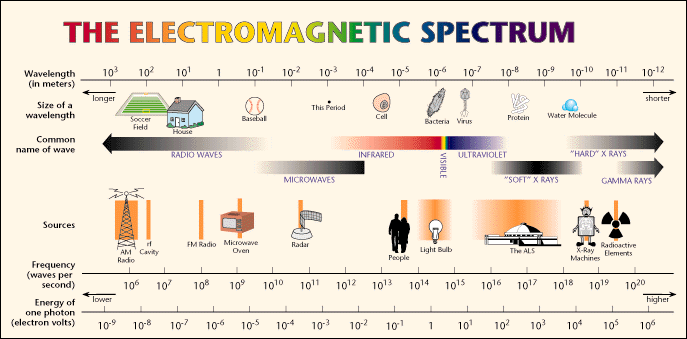
The length of a wave, its associated frequency (“wavelengths” or “cycles” per second) and energy determine its usage (see Figure 1).

Figure 1: The Electromagnetic Spectrum


Source:
http://galileo.phys.virginia.edu/classes/USEM/SciImg/home_files/introduction_files/EMSpec.gif
  1. Radio waves are relatively long, with wavelengths from 1,000 metres (1 km) to 10 cms, and frequencies from 3 kilohertz (3,000 cycles per second) to 3 gigahertz (GHz) or 3 billion cycles per second for the shortest, sometimes also called microwaves. (There are longer waves, e.g., electric power, of several km.)
  2. Microwaves in the centimetre and millimetre range can have frequencies up to 300 GHz. There is an overlap in terminology depending on use; microwaves for cooking use several hundred watts of electricity at RF wavelengths of about 32 cms (915 MHz) and 12 cms (2.45 GHz). Microwaves from low-powered devices of a few watts at these frequencies are used for communications, and emit insignificant heat.
  3. Infrared waves are smaller, and are felt as heat, e.g., from lamps and infrared grills used for cooking. Higher infrared bands used for communications in remote control devices and for imaging/night vision have no heating effect.
  4. Wavelengths between 700 and 400 nanometres (about 430 to 750 terahertz or THz) form the visible spectrum from red to violet, combining to form white light. For example, we perceive wavelengths of about 635-700 nm (430-480 THz) as the colour red.
  5. Shorter wavelengths form ultraviolet rays, of which those around 380-280 nm cause sunburn. Sunlight at sea level comprises about 53 per cent infrared, 44 per cent visible light, and 3 per cent ultraviolet rays.
  6. Yet smaller waves are classified as X-rays, and the smallest as gamma rays, both used in medical and industrial imaging.

The sweet spot in the RF spectrum for telephony and the Internet

For telephony and broadband, lower frequencies (700-900 MHz) are most cost-effective, as they traverse long distances without attenuation, penetrating walls and foliage. Radio waves in the atmosphere are affected by water vapour and ionisation, as well as events such as solar flares with bursts of X-rays. Depending on temperature, moisture, etc., radio waves may be absorbed, refracted, or reflected in the atmosphere, and by hills or other obstacles. Low frequency waves penetrate buildings and trees, and curve over slopes. Higher frequencies are more absorbed or reflected by the atmosphere; they are also more attenuated by distance and rain. Networks at lower frequencies require fewer towers than at higher frequencies.

What are 2G and 3G?

These signify different stages of technological development, starting with 1st Generation (1G) analog wireless in the 1980s, e.g., in car phones. 2G (2nd Generation) began in the 1990s with the digital wireless GSM standard for mobiles, extending to other standards, e.g., CDMA. 3G (3rd Generation) has faster data speed and greater network capacity.

What is 2G/3G spectrum?

There is no difference in the spectrum; only the convention of government regulations and harmonisation between countries by the International Telecommunication Union (ITU) earmark wavelengths for different applications. Both 2G and 3G can and do work at 800-900 and 1800-1900 MHz.

Combined with the advantages of prices dropping as volumes rise, one estimate puts 3G coverage with 900 MHz at 50-70 per cent lower cost than at the designated 2.1 GHz. 3G networks using 900 MHz (“2G spectrum”) exist in Finland, Iceland, Australia, New Zealand, Thailand, Venezuela, Denmark and Sweden, and countries like France encourage 2G networks to upgrade to 3G services.

Spectrum allocated for 2G and 3G by various countries is at Figure 2; the current and proposed allocation in India is shown below.


-->
* Existing # Proposed BWA: Broadband Wireless Access
[For details on 2G GSM & CDMA in November 2009, see: http://mobile.broadbandindia.com/2009/11/complete-2g-spectrum-allocation-info.html.

For proposed 3G and BWA auction bands, see:
For National Frequency Allocation Plan 2008: (Care - ~ 67 MB!)

This shows India’s dearth of spectrum for public use because of government and defence allocations. We need innovative methods to maximise capacity given our needs, limited landline networks, and the relative costs. (For details on the chart, please see: http://www.umtsworld.com/technology/frequencies.htm)

For example, China has allocated 250 MHz in the 800/1800 MHz bands. By not charging auction fees and spectrum charges, ubiquitous networks were built at lower cost with high capacity. These result in lower costs for users and higher productivity. With its focused approach, China also developed its own standard (TD-SCDMA).

India’s spectrum allocation is burdened with short-term revenue collection for the government, and a shortage mentality. There is apparently insufficient clarity on spectrum usage for ubiquitous broadband/telephony as in other countries, let alone more ambitious targets, such as developing an Indian standard.

Our policies could address the requirement for enhanced coverage/capacity at low cost to make services available everywhere at reasonable prices. Innovative approaches to spectrum management could help get these, through:
  1. Technology-neutrality: the UK and Norway have not restricted the use of recently auctioned spectrum to any technology.
  2. A focused strategy for service delivery at low cost, as in China.
This needs a combination of methods, e.g., along with technology-neutrality, (a) data-base driven, shared spectrum usage, under trial in the US, (b) “Cognitive Radio”, whereby smart devices sense available channels for dynamic, non-conflicting use in unlicensed spectrum bands, (c) incentives for rural broadband delivery, e.g., by subvention of fees and government charges, with (d) subsidies.

                                                      shyamponappa at gmail dot com


Footnote - Added later: May 26, 2013

1 What is Spectrum?


A more detailed explanation requires an understanding of the interrelated concepts of energy, work, and force, which are explained below.  Those who are not interested in technical details are advised to skip the box below to the paragraph with the diagram.

Energy, Work, & Force

Energy is the capacity to do work.  More precisely, it is the state or property of a system that enables it to perform work.  Work is defined as the change in position of an object, or of the state of an object or another system in motion or at rest through a transfer of energy to it, e.g., its temperature, which is a measure of the random motion of the particles comprising that system, or of the amount of light (i.e., radiant energy) or chemical energy in it, or its state of motion or rest.

Work is done through the application of force, the expending of any form of energy.  The major forms of energy are: electromagnetic radiation -- including RF spectrum, light, gamma rays, x rays, and so on; electrical energy; thermal energy or heat; mechanical energy; chemical energy; nuclear energy; sound energy; and gravitational energy.  Force is any influence that produces change in an object's or system’s state of motion or rest, or in its internal state.  Force has both direction and magnitude.  There are four known “fundamental forces” or “interactions” in physics:

- Gravitation, which affects all objects with mass.  Every object exerts a gravitational force on all other objects.  It is the weakest interaction, operates over infinite distances, and governs the structure of the universe. 

- Weak interaction, which affects all particles, and operates only at very short range.  It acts at the subatomic scale of atomic nucleii.

- Electromagnetic interaction, which affects all particles, has infinite range like gravity, and is much stronger than both gravity and weak interaction.  This form of interaction is responsible for the attractive or repulsive forces between electrical charges.

- Strong interaction, which affects subatomic particles called hadrons, which are themselves made up of quarks.  This type of interaction binds the nucleons in the nucleus of all atoms with the strongest force, operating at very short range.

These interactions hold particles together and organize them into complex objects (http://keyhole.web.cern.ch/keyhole/theory/main-5.html).  For details on the fundamental forces, see http://hyperphysics.phy-astr.gsu.edu/hbase/forces/funfor.html; for more about electric and magnetic charges and fields, see http://en.wikipedia.org/wiki/Electric_charge.


Electromagnetic radiation is pure energy without mass, and consists of waves of electrical and magnetic energy (see diagram below). 


These waves consist of a stream of photons, which are packets of energy that can be thought to behave like waves.  The energy in a stream of photons determines what kind of wave it is, i.e., whether they are light waves that we see as visible light, or radio waves or X-rays that are invisible.  This energy also determines the effect the photons have when they come into contact (interact) with particles of matter.

What Gives Rise To EMR?

All matter consists of atoms, which consist of mostly empty space.  Atoms are made up of negatively charged electrons revolving around a nucleus at the centre, which comprises positively charged protons and neutrons with no charge.  For example, a hydrogen atom has one proton and one neutron in its nucleus, and one electron in orbit.  The atom is 100,000 times the size of the proton.  This means if the nucleus of the atom were enlarged to the size of a tennis ball (6.5 cm), its electron would be at a distance of 6.5 km away; hence the mostly empty space. 

When energy is absorbed by an atom, one or more of its electrons shifts to a more distant, higher-energy orbit around the nucleus.  When the electron returns to its original level of orbit, energy is released as EMR and/or in some other form/s.  Depending on the material of the atom and the amount of energy released, the energy takes the form of heat, light, EMR, or other radiation such as X-rays or gamma rays.

SP
May 26, 2013

Tuesday, September 8, 2009

Making Broadband Happen


There are opportunities to repeat the success of NTP '99 with 3G and Broadband Wireless Access

Let’s take stock of the Empowered Group of Ministers’ reported decisions on spectrum auctions for 3G and Broadband Wireless Access (BWA, aka WiMAX), and see what remains to be done.

To recap briefly:

  • There will be four bidders for spectrum designated for 3G, making for five operators per circle including MTNL or BSNL.
  • There will be three bidders for spectrum designated for BWA, making for four operators per circle including BSNL/MTNL.
  • The reserve price for a pan-India 3G license will be Rs 3,500 crore for 5 MHz (about $700 million).
  • The reserve price for a pan-India BWA license will be Rs 1,750 crore for 10 MHz (about $350 million).
  • Pre-bid conferences will be held in the next few weeks, leading to auctions in the next three months.

    Assessment

    1. There is one sound aspect to the decisions, while other aspects seem less so. The good one is limiting the operators to five per circle for 3G, and four for BWA. This signals an excellent, forward-looking approach aligned with best practices. A limited number of operators can have contiguous bands of spectrum. This will provide the freedom and incentive to build networks and offer services aggressively.

    2. As demand for spectrum exceeds supply, serious bidders may be excluded. The EGoM could remedy this and simultaneously address another problem, the issue of unused spectrum, through establishing policies for resale. Unused spectrum is akin to speculative property investments without development waiting for asset prices to rise before resale, or locked granaries when food supplies are low. As with land at favorable prices for setting up industries, access with development conditions maintained by the actual rule of law with real-time monitoring— no back-door deals, after-the-fact regularisation as with CDMA, or predatory or duplicitous behavior— will probably result in the greatest collective benefits.

    3. The EGoM should also explore spectrum-sharing, i.e., non-exclusive spectrum use on common carrier principles. A technically and commercially informed effort for shared usage could lead to optimised use of available spectrum. For this reason, it is important that consultations include companies like Ericsson, Nokia, Motorola and Qualcomm, and Internet service providers. It is also critical that the government's advisors include experienced Radio Frequency Engineers (RF engineers) who understand the capacity and limitations of radio waves, as well as IT and regulatory experts including the TRAI. These considerations are critical for informed decisions, and consultations should not be restricted to economic, financial, legal/regulatory, tax and accounting issues. Because of the potential conflicts of interest, it is advisable that technical expertise should be from outside/or in addition to the DoT/BSNL/MTNL.

    4. A third area for consideration is technology neutrality: unrestricted use for services delivered (within amended regulations). In other words, any communications service for voice, data or multimedia to be allowed on any spectrum band, with any equipment (2G, 3G…), using any technology.

    Removing technology restrictions will permit unconstrained service delivery, resulting in optimal spectrum usage. Currently, e.g., BWA can be used only for data transmission; 3G spectrum is meant for 3G equipment. In fact, different technologies can use the same frequencies. Radio waves can be propagated farther with less power at lower frequencies, resulting in lower costs. One estimate is that 3G at 900 MHz can be built at 60 percent lower cost than in the 2.1 GHz band.* However, there is also the issue of harmonisation: aligning with the way technology evolves globally, so that volumes and experience yield lower costs. Service providers should be able to choose spectrum use depending on markets, technology (present and future), regulation, and commercial logic.

    Instead of self-imposed restrictions on technology, our policies should seek to optimise usage of spectrum and technology for societal benefits through a network delivering voice, data and video. The present restrictions undermine project economics especially in sparsely-populated areas, whereas an ability to offer all feasible services is both reasonable and commercially compelling, as a basket or bouquet of services offers more to users, and service providers benefit from the efficiencies.

    Conclusions

    There are two sets of issues that deserve the EGoM’s consideration:

    1. Technology issues, and

    2. Pricing and regulatory issues.

    Technology and restrictions

    a) Voice over Internet Protocol: Enabling VoIP in line with international practices will benefit users, but will raise issues of protecting BSNL/MTNL's revenues. This needs constructive resolution; however, it should not be at the cost of the public interest in prohibiting VoIP [while beyond the scope of this article, I think that with the right attitudes, leadership, strategies, and alliances, BSNL and MTNL could be effective service providers].

    b) Permit any service/equipment with any frequency and technology, in line with amended regulations. Thereby 2G, 3G and BWA (and later, LTE) could be on any frequency.

    c) Share spectrum usage if possible (common carrier principles, or other arrangements).

    Pricing & Regulations: Repeat the Success Of NTP ‘99

    a) Enable resale of spectrum, including forced resale of unused spectrum, and price caps or claw-backs on speculative gains.

    b) The EGoM should consider lower reserve prices to maximize service roll-out at reasonable prices. It could be on the lines suggested in December 2008 by the Cellular Operators’ Association of India (see table), or an approach arising out of the consultations, to lower bids so that users get good services at low prices countrywide.


  • c) TRAI can set appropriate price ceilings, factoring in the lower bids.

    d) Set annual spectrum charges with incentives, e.g., reduced revenue share for service delivery on a real-time measure, graded higher for rural areas.

    When I first suggested revenue sharing for telecommunications franchises in 1998 to replace license fees from auctions, many dismissed it as unrealistic. However, after NTP ‘99 came through and after a reduction in revenue share percentages, there was an incredible boom in telecommunications services. Simultaneously, the government's revenue share greatly exceeded expectations. The EGoM can recreate this success with wireless broadband.

    shyamponappa@gmail.com

    * ‘Prospects for UMTS900: status review and outlook’, Catherine Viola: http://www.analysysmason.com/Research/Content/Reports/RDTN0-Prospects-for-UMTS900-Apr2009/