Showing posts with label Google. Show all posts

Thursday, August 6, 2020

Configuring India's Digital Ecosystem


Policies must favour consortiums of local players - for operators with a government stake, and for manufacturers/system integrators with market access conforming to WTO rules.
Shyam Ponappa    |   August 6, 2020 
Two developments highlight the need for government to sponsor consortiums to build India’s digital ecosystem:
  • Facebook’s announcement in April to invest $5.7 billion in was momentous. In a slowing economy, Reliance Industries raised an incredible $20 billion with a cascade of foreign investments combined with a rights issue. This “consortium” makes Reliance debt-free, besides providing the capital and capacity to dominate communications in India.
  • India’s digital ecosystem’s dependence on China and on increasing imports underlines the imperative for corporate India to come together in a national endeavour that must succeed.

The Jio factor
Overwhelming dominance rarely benefits the public interest, even if the pricing starts incredibly low. Developed markets frown on monopolistic dominance, despite there being giants such as Microsoft, Google, Apple, Amazon, and Facebook.1
Discounting tall talk, India’s communications sector now has these upbeat expectations, along with a slew of old negatives, particularly the debt- and tax-burdened, fragmented other operators together with recalcitrant policies. Government-imposed charges and tax battles burden our operators, rendering them unable to compete.
How have Jio’s moves affected the public interest? With both benefits and detriments. The negative fallout from sectoral debt from auctions and crippling government levies, and a price war, has been unsustainably low tariffs. A positive effect is that data traffic increased greatly because of the low tariffs. Yet, the results are damaging: For service providers because of insufficient profits, for the market because it constrains quality and growth, and, therefore, for consumers in the short and long run. Service levels are compromised by resource constraints (dropped calls, slow speeds), and because of under-served customers — both in existing and the unserved markets in India. Data traffic may have increased simply because more people watch more rubbish in video form, whereas service providers need the wherewithal to invest, to improve and extend coverage, as well as to design constructive educational, skill-building, medical services, and other enhanced interactive services for users’ genuine benefit. In that sense, traffic as a measure of user benefits can cut both ways.
Apart from data, two other aspects merit consideration: Operator revenues, and government collections (licence fees, auction charges, and taxes). Operator revenues grew strongly from mid-2003 through FY2012, flattened for five years (FY2013-17), then declined after FY2017 (see Chart 1).
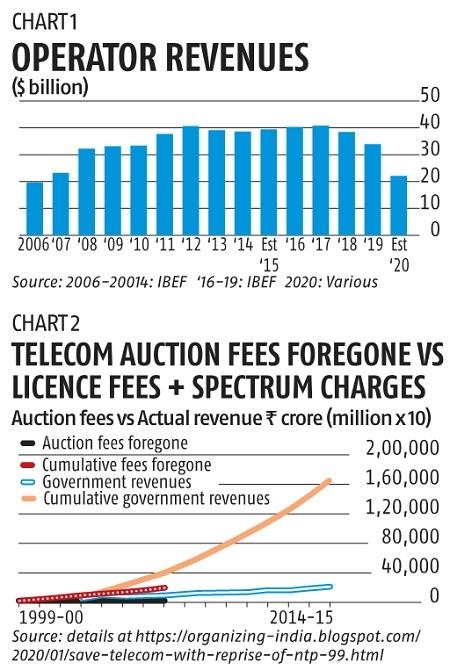
Barring additional charges, government revenues reflect this decline, leaving these lingering questions:
  • Does the declining trend serve the public interest?
  • What is the opportunity cost of disruption and deprivation of services?
A third issue requires action: How do we improve our digital prospects? Note that government collections from licence fees and spectrum charges rose steadily from FY2004, so that cumulative revenues far exceeded auction fees foregone (Chart 2). Corporate taxes were in addition to this.
Thereafter, government collections flattened, then declined (barring retrospective charges), as did taxes. This calls for policy intervention to enhance services, thereby increasing revenues and government collections. Straightforward adoption of global norms for wireless in 60GHz, 70-80GHz (V-band and E-band) and unused UHF (500-700MHz) restricted to operator use will help.2 So will giving up the farce of reviving BSNL/MTNL, including the hopelessly snaggled VRS, and the botched tenders (‘Most of it to Huawei?’ ‘No, Ericsson and Nokia.’ ‘Alright, 10 per cent to domestic suppliers.’ ‘No, all of it to domestic suppliers…’).
Competition for Services
A way to nurture balanced competition in services is for the government to create a consortium with a minority anchor, bringing financial, technological, and delivery capability to compete with Jio’s dominant platform.
Reliance Industries Chairman Mukesh Ambani calls for doing away with 2G; Airtel Chairman Sunil Mittal calls for supportive policies, and repudiating old battles such as contention over the adjusted gross revenue (a 15-year battle won in lower courts, lost in the Supreme Court), and reducing exorbitant charges. The government can change policies to achieve these. It can stop predatory practices, and facilitate this consortium. BSNL/MTNL can be genuinely supported to be the government anchor in the consortium with a minority stake, with golden-share national security, public- and minority-interest responsibilities through appropriate legislation. Airtel could be the lead, with others participating, including foreign players.

Equipment Consortium
Fragmented suppliers and system integrators also need a consortium for collaboration. While multinational vendors dominate, dependence on imports and China is untenable for our increasing and strategic requirements. Absent enabling policies, Indian manufacturers have to succeed offshore to sell within the country. Why do such things happen? Many reasons, starting with the holdover of colonial mindsets even of those who want to rewrite history, which treat the government — whoever is in power — as the colonial/feudal overlord, and the people as serfs with a vote, whose weaknesses can be pandered to for electoral victory. This imposes a zero-sum framework—the government versus the rest (Us versus Them).
In reality, the situation need not be zero-sum, as evidenced by past service growth and government collections through revenue sharing, compared with what might have been if auction fees were enforced: Bankruptcies and no services.
The prerequisites are (a) policies framed to provide access to local manufacturers and service providers conforming to WTO requirements; (b) their market access through continuing orders; (c) their collaboration to supply, install, and facilitate operations and maintenance of requisite equipment.
If these were made possible, domestic suppliers could meet a significant share of India’s communications needs. This requires emulating the Huawei model — easier said than done!3
The Union and state governments need to understand these components, and execute them from a national perspective, without bombastic rhetoric, politicking, fund-raising for elections, and so on. Policies must incentivise coordinated action; orders have to be winnable by including criteria for development of domestic capacity to conform to the World Trade Organization rules; and execution has to be first rate (on time, high quality). Digital communications will drive many aspects of all sectors. Our policy-makers must stop dithering and help us prepare effectively.

Shyam (no space) Ponappa at gmail dot com
1. For issues about competition laws in India, see: Amber Sinha & Arindrajit Basu, April 30, 2020:
"Analysis: Reliance Jio-Facebook deal highlights India’s need to revisit competition regulations"

Thursday, May 2, 2019

Democracy, Digital India and Networks


Digitisation and democracy are ruled by the ineluctable dynamics of networks.
Shyam Ponappa   |   May 2, 2019 


There’s no escaping the blessing or the curse of the Digital Age in India, any more than the benefits and challenges of democracy. The headlong rush into digitised networks provides incredible benefits of reach and efficiency in many different ways, at the individual and many collective levels — of family, friends, community, nation, polity, work, domain, and so on. It also lends itself to the dark side, plumbing the depths of social, religious, or political factions and tribalism, bigotry, autocracy and fascism, anarchy, social dysfunction, and the rest. Yet, there’s no denying that for India, with all its needs, talents, foibles, and contradictions, digitisationis a great enabler.


Likewise democracy.  Romanticised notions of it are pure fluff, epitomised by selfies at the Parthenon, conjectures about Vaishali, or the spectacle and pageantry of electioneering. The reality was, and is, much harsher, whether then or now. Then, it was the practice of a pri­vileged elite. Now, the reality of de­m­ocracy in India with universal franchise and an insufficiently prepared polity is a space captured by politicians, many of them fractious opportunists, not really prepared or equipped for the complex analysis and decision-making that governance requires. Mo­st citizens, however, have an illusory freedom of choice, despite the choice being restricted to accepting or rejecting incumbents, or choosing repla­cements from among th­e­se very politicians. This is where digitisationhas a direct role and enormous impact through media in all its forms, in­cluding the nexus between money and politics as in the Cambridge Analytica episode.

According to McKinsey’s ‘Digital India’ report of 2019, the benefits of digitising India are impressive, although only 40 per cent of the population has internet access, and there is uneven adoption in businesses, leaving considerable room for improvement. Yet, newly digitising sectors have experienced tremendous gains. For example, in logistics, fleet turnaround time has been reduced by 50 to 70 per cent, and digitised supply chains helped companies reduce inventory by 20 per cent. The question is whether and how this can be managed to yield more benefits than detriments, while preserving privacy, social convergence, and harmony, while avoiding divergence, repression, and instability through disharmony.

The Imperative for Conscious Regulation

Network science tells us that real-world networks share two characteristics. The first is growth with time, and the second is that new nodes link more often to more connected nodes, or hubs. Growth and preferential attachment result in the emergence of a few, highly connected, dominant hubs in all networks, whether the networks are of the cells in our bodies, computer chips, transport networks for airlines, social networks connecting people, or the World Wide Web. These characteristics are common across networks of any size and are scale-free.  
Added later: June 7, 2019
[Re the scale-free aspect, for opposing views, see: liorpachter.wordpress.com/2014/02/10/the-network-nonsense-of-albert-laszlo-barabasi/]

Added later: June 15, 2019
[Scale-Free Networks Are Rare-Anna D. Broido and Aaron Clauset-arxiv.org
https://arxiv.org/pdf/1801.03400.pdf]
The dominance manifested by companies such as Facebook, Amazon, Netflix, and Google, combined with the attenuated influence of less connected nodes highlights the role of regulation and structure for equitable development and outcomes in networks. The same issues of dominance and the need for regulation arise in democracy.  In India, outrageous changes introduced recently with regard to election funding have increased opacity and the potential for abuse at the heart of democratic processes. Political parties can now receive foreign or do­me­stic funding from any source without constraint, and funds can be anonymous through ele­ctoral bonds. Introduced with retrospective effect, both the National Demo­cratic Alliance and the Congress benefitted, as previous adverse judgments were nullified. Therefore, one pointer is the need for regulation and appropriate controls applied in a host of areas including news and social media.
Evidence-Based Policies

An entirely constructive aspect of digitisation relates to the application of network science to issues by mapping the links between factors and actionable policies. Examples are the connection between genes and diseases for effective treatment,1 or the feasibility of upgrading products and exports for countries. An example of how proximate products and exports developed over 20 years is visualised in Chart 1, showing the Revealed Comparative Advantage (RCA) of Colombia (COL) and Malaysia (MYS) in production and exports from 1980 to 2000.

Chart 1: Revealed Comparative Advantage – Colombia and Malaysia


Source: Hidalgo et al: ‘The Product Space Conditions the Development of Nations – Science, 27 Jul 2007).  https://science.sciencemag.org/content/317/5837/482

The premise is that most upscale products are from a densely connected core, while lower order products are in a less connected periphery. Countries tend to move to products close to those for which they have specialised skills.
The lower chart is for Malaysia alone (it helps to view enlarged images in co­lour on a screen to trace the progression).

India’s manufacturing and export opportunities in its product space in 2017 are in Chart 2.


Chart 2: India - Export Opportunities Product Space - 2017  $292 billion


Such interactive charts are available and can help in planning for product areas such as automobile parts, chemicals, or electric motors.2

A great deal of appropriate regulation followed by planning and execution is needed, incorporating insights such as these in areas like governance, healthcare and industrial policy. Realpolitik and preoccupation with obscurantism, religiosity, and caste/tribe, require that changes be driven by unraveling the nexus between politics and funding, evolving a transparent, state-funded system. Is such a transformation possible? Recent developments that have overtaken earlier attempts at electoral reform such as the Goswami Committee (1990) and the Vohra Committee (1993) emphasise an urgent need. But can public opi­ni­on and opportunistic opposition interests converge to effect appropriate cha­nges in political funding? And elicit enlightened government action in public interest projects for health, manufacturing and export policies, agriculture, finance, construction, and so on? A tall order. Perhaps the best hope is that reactions to phenomena such as Brexit help create more equitable practices.


Shyam dot Ponappa at gmail dot com

1. For connections between diseases and genes, see Alex J. Cornish et al: https://genomemedicine.biomedcentral.com/articles/10.1186/s13073-015-0212-9

2. https://atlas.media.mit.edu/en/
AJG Simoes, CA Hidalgo. The Economic Complexity Observatory
 
'An Analytical Tool for Understanding the Dynamics of Economic Development.' Workshops at the Twenty-Fifth AAAI Conference on Artificial Intelligence. (2011)

Thursday, February 1, 2018

Matching Realities and Aspirations


Leaving aside fixing the 'mountains' such as land acquisition, NPAs, etc., here are some thoughts on systemic focus and action.

Shyam Ponappa    |   February 1, 2018


There’s an upbeat sense from the annual Economic Survey, and indicators such as soaring stocks and official statements.Yet, the ground realities don’t match because of gritty facts such as not being able to pay electronic tolls on a national highway near Delhi though the Bharatiya Janata Party (BJP) controls local administration1, Korean steel giant Posco abandoning a huge investment last year after struggling for over a decade, two public sector divestments, Bharat Aluminium Company and Hindustan Zinc, mired in difficulties2, or the hobbling state of services such as electricity and telecommunications despite short-term consumer benefits from lower prices, and so on. Another aspect is that so many college graduates, including engineers, law students and MBAs, compete for low-end government jobs such as peons in state governments. Clearly, something beyond talkfests and episodic discussions is needed. Leaving aside fixing the “mountains” — the land acquisition act, non-performing assets (NPAs), high component taxes — here are some thoughts on systemic focus and action.
Fix infrastructureWith rare exceptions, our governments do not appear to recognise a clear priority to fix infrastructural deficiencies. After national security and maintaining law and order, correcting critical deficiencies of infrastructure in all its forms needs to be an all-out priority. This is a basic requirement for citizens to function effectively and live well. Without infrastructure one cannot function anywhere near full capacity, because of having to spend time, energy and resources dealing with problems of living and hygiene arising from the non-availability of adequate water and sanitation, inefficient travel and logistics for employment, education or health care, communications, dysfunctional equipment because of power shortages, and so on.Instead, some misconceptions in policies and practices appear to be broadly accepted as driving factors not only in the government, but also to some extent in the public perception. One is that all foreign direct investment (FDI) is a panacea for our ills and aspirations. The second is the idea that for services such as water, electricity and communications, the public interest is best served by the lowest consumer prices for those who get such services, regardless of sustainability. Issues such as access to services for half the population living outside urban areas, high and consistent quality, sustainability, and minimising environmental impact appear to be less important criteria.


The Panacea of FDI?There’s no question about the need for foreign investment, but uncontrolled FDI, particularly at our stage of development, is inadvisable. One wonders where these forms of the erstwhile East India Company and/or winner-take-all might lead. And does it matter, as long as consumers enjoy good living, defined as access to material comforts at low prices? To see why it does matter, consider these parodied scenarios, with apologies to Jonathan Swift’s satirical A Modest Proposal3.A Modest Proposal for 100% FDI — A ParodyImagine how well all consumers could do, this time without leaving the other half out, if we invite the likes of (indicative list, in alphabetic order) Amazon, Facebook, Google, and Microsoft (with guarantees of compensation if there are sudden policy reversals, which we are prone to) to use all unsold and unused spectrum to provide connectivity and digital services pronto. They could put in so much investment to get to year five on day one a couple of years or so out, even Reliance Jio might pale.Don’t want Americans? Why not invite the Chinese and Huawei? We might get even better deals in digital services from the world leader in 4G and beyond.
Not to mention the attendant benefits from associated companies to keep consumers happy with smartphones, air conditioners, refrigerators, air purifiers, TV sets, cars, two-wheelers, and so on. There will also be power plants, aircraft, and trains, fixing all three sectors with one swipe. Some impediments would have to be removed of course, such as allowing power plants to come up, electricity lines to be laid out, spectrum to be used, land acquired, changes in labour laws, and so on. As for employment, there could be plenty of local assembly, manufacturing and distribution from all of the above, provided we willingly submit to some regimentation in our lives.

Alternative: Fix The Basics & Do It Ourselves
We have to fix the basics to help ourselves and make FDI succeed in our interests. We need priorities in objectives, as everything cannot have the highest priority. Even more difficult is getting experts and practitioners to work out detailed process plans, evaluating alternatives with realistic simulations, and so on. It takes time, energy, understanding and competence, and patience, to get beyond seat-of-pants discussions. Apply all these from a systems perspective, map the distilled ideas to action plans for each set of interrelated processes, and the upshot could be those process plans. We may get end-to-end strategies leading to convergent results to improve our infrastructure, which will enable agricultural and manufacturing production, services, and trade, with resulting jobs, while limiting negative environmental impact.Goals such as increasing jobs and farm income are desirable. To get on a higher long-term growth trajectory beyond a cyclical recovery, in addition to skilling, there need to be initiatives and investments that fit with the circumstances. An excellent example is the Automotive Mission Plan 2006-2016, now in its second 10-year cycle, which resulted in India becoming a preferred automobile assembly location with 32 million jobs in FY16. Similar approaches could be worked out for connectivity, electricity, and the rest, that address the needs/opportunities/markets, the products/services, how delivery will be organised, what the resources are and where they will be sourced from, how they will be organised and when, i.e., the detailed strategy, process plans and flow charts.Also, effective corporate practices such as facilitation for catalysing group decisions could be used if they are not already, to help administrators, experts, and practitioners arrive at sound, practical decisions.4 Another area is simulation and modelling of alternatives and scenarios. A third is overall strategy.


These steps will help improve our ability to achieve our aspirations.


Shyam (no space) Ponappa at gmail dot com
1. ‘India’s road to digital highway’, Nivedita Mookerji, Business Standard: http://www.business-standard.com/article/opinion/india-s-road-to-digital-highway-118012401544_1.html
2. ‘India as a ‘business partner’, Kanika Datta, Business Standard: http://www.business-standard.com/article/opinion/india-as-a-business-partner-118012401599_1.html
3. https://en.wikipedia.org/wiki/A_Modest_Proposal;https://andromeda.rutgers.edu/~jlynch/Texts/modest.html4. https://www.centreforfacilitation.co.uk/files/public/What%20is%20process%20facilitation.pdf

Friday, October 2, 2015

Digital India - Now to Work


Despite the PM's interest, much remains to be done.

 |  October 2, 2015

There's a buzz about Digital India again with an Indian PM finally reaching Silicon Valley. So are we close to broadband taking off, or is this just more hype?

The announcements are certainly promising. For instance, that Indian Railways will provide Wi-Fi services at 500 railway stations over the next few years. Google's support tendered by CEO Sundar Pichai offers new hope that this will happen. Other promising announcements include Microsoft CEO Satya Nadella's announcement of cloud-based services from India, and connectivity at the village level through TV White Space (unused broadcast spectrum), and Qualcomm CEO Paul Jacob's $150-million fund for start-ups in India.

There have been announcements like these before. For instance, the Railways announced Wi-Fi projects for years, with modest achievements. For details, see "A history of Wi-Fi and Indian Railways from 2006 to Infinity (maybe)".1


What's troubling is that in terms of ground realities, except for TV White Space for broadband, there's little evidence of a systematic approach to problems besetting communications, and changes in policies to solve them. Everyone seems carried away, and this is as true of most of the media and the commentariat as it is of the politicians. But informed, systematic efforts at solutions are absolutely essential to achieve these aspirations.

Take the ingenuous comparisons of Silicon Valley with Bengaluru, with the latter being described as "nearly there". Such election rhetoric from former US Senator and Secretary of State John Kerry is one thing, but our savvy media folk should know better. People who visit Silicon Valley from India, or those who are based there and occasionally visit India, can't be blind to the stark differences. One is a place where the basics related to living and functioning effectively actually work well; the other isn't. One has potholed streets with garbage, decrepit or nonexistent sanitation, and chronic power cuts; the other doesn't. It's as simple as that.

This leads to another observation that's tossed off too easily, about less need for government. Blithe statements that government needs to be reduced, or to get out of the way and let the private sector function, are often made with apparently little understanding of what governments do before getting out of the way. Those essential services in Silicon Valley and elsewhere that function seamlessly and are taken for granted? That's what governments can do. In other words, that is government's responsibility: to provide, apart from security and law and order, the infrastructure services and organisation of communities, markets and financial systems that enable citizens to function effectively and live well. Yes, markets are indeed planned and structured in order to function well.


The data on broadband at the end of 2014 in the Broadband Report 2015 by the ITU and Unesco suggest that India is not doing too well compared with its developing neighbours in Asia (see chart below).2  Our leadership and government need to confront this reality, and apply themselves to reforms to improve conditions. Broadband subscriptions as a percentage of our population trail most countries, and the percentage of individuals using the Internet is at the bottom of the pack, with Myanmar, Bangladesh, Pakistan and Nepal.


To make Digital India a reality, here's what the government needs to do:


  • Trials using TV White Space (TVWS, or unused broadcast spectrum) for broadband are finally under way, after years of struggle to get them going. If they work out, policies must be framed quickly for this spectrum to be bundled with fibre backbones such as BharatNet (the erstwhile National Optic Fibre network), and licensed service providers given access at reasonable cost.
     
  • Policies need to be formulated with government and operators working together, instead of as adversaries. This will increase the probability of success, as the private sector can be convinced of and contribute to practicable methods that they accept.
     
  • Policies for sharing spectrum can be extended to other under-used spectrum held by the government and Defence (secondary sharing, as in the USA), and to networks as well. This will facilitate broad, contiguous spectrum bands that are essential to support rising data usage that is affordable. Policies must also enable authorised operators to access all networks, fostering competition while increasing revenue potential and reducing costs. The data on broadband at the end of 2014 in the Broadband Report 2015 by the ITU and Unesco suggest that India is not doing too well compared with its developing neighbours in Asia. Our leadership and government need to confront this reality, and apply themselves to reforms to improve conditions.
  • The TVWS devices are manufactured by relatively small companies abroad with the exception of Huawei, which acquired Neul, one of the pioneers in the UK. Indian innovators can produce such devices locally, but only if they have a supportive ecosystem. That means sufficient continuing orders to create revenues for sustainable profits and cash flows. In a market like India, such orders need government support until new policies are in place and the demand is established. Once that happens, private enterprises can compete.

    For instance, a chip designer start-up in Bangalore with designs for TV and broadband cards using TV White Space has had to scramble to manufacture complete products to bring their prototypes to market. Without sustained buying, they'll languish like other device manufacturers overseas, with episodic sales to narrow markets. That's because developing economies are likely to be bigger markets for these devices than developed economies, but only after policies allow deployment; secondly, there's insufficient support in developed markets. The irony will be if Indian innovators can get only offshore prospects like Huawei as partners or investors.
     
  • Unremitting government effort in the systematic development of basic infrastructure services (at the primary level, besides communications, there's power, transportation, water and sanitation, basic health and education; at the secondary level: communities, markets and financial systems) will round out the potential for India as a producer economy as well as a large and growing market.

This is the work that now needs to get done: accept the reality of our infrastructure deficiencies, change our spectrum and network sharing policies, plan step-by-step, and execute for results.


Shyam (no space) Ponappa at gmail dot com


Thursday, June 6, 2013

Law & Order Through Traffic Systems


A TV white space system for traffic management may yet induce us to observe discipline and law-abiding behaviour

Shyam Ponappa / Jun 06, 2013

In such chaotic times, should we even consider minor themes, like trying to bring order to our traffic, and our behaviour on our roads? Yes, if one accepts that turmoil and crises provide opportunities as much as threats, and because these areas are among the few in which there may be chances of success if there are well-directed efforts. Instead of passively being buffeted by fate, we can do something about it: analyse the causes of our horrific traffic, devise an approach to mitigate or contain some factors, and formulate and implement solutions. Also, the technology is readily available, and the solutions need not be all-encompassing efforts on a countrywide scale, or not at all. Hence this pitch for a technology- and institution-driven, systems approach to  that could potentially change the way we are. The big assumptions are: (a) that systems can induce order and law-abiding behaviour on our roads, for a start, and (b) that this will reduce . Let's consider how.

Traffic Accidents & Deaths


Information on traffic accidents is available from the National Crime Records Bureau at the ministry of home affairs. The latest report available is for 2011. There were 473,084 reported traffic accidents in 2011, comprising 440,123 , 2,385 "rail-road accidents" and 30,576 "other railway accidents". The figure for accidental deaths from unnatural causes was 367,194, of which traffic accidents accounted for 165,072. The latter included road and rail accidents, but excluded deaths from drowning and accidents involving aircraft. Road traffic accidents and deaths countrywide and for the Union territory of Delhi for the last five years are shown in the graphs below.


While frightful enough, the graphs do not quite convey the horrid rough-and-tumble unpleasantness of our roads. Could there be some way to bring order to this aspect of our lives? Perhaps, if we can imagine better scenarios, and then apply ourselves to act collectively to achieve them. It may be possible to introduce systems that elicit better governance and behaviour, as in the following instances.

Wireless smart grids and TV white space


An early example of augmenting existing communications networks with TV "white space" (ie, the unused TV spectrum) devices was implemented in America, in the city of Wilmington in North Carolina and its environs of New Hanover County. The City of Wilmington has about 100,000 people in about 105 square kilometres, while the county has a population of nearly 200,000 in an area of about 515 square kilometres.1

Because of the distance between localities, the extent of wetlands and waterways, and the dense foliage, extending broadband coverage to all its residential areas was difficult and expensive. In January 2012, Spectrum Bridge helped with installing a wireless overlay in three locations using TV white spaces to provide broadband connectivity. Additional equipment enabled real-time traffic monitoring to improve efficiency, reducing congestion and travel time, as well as aiding in law enforcement, in disaster management such as hurricane evacuations, and in enabling broadband connectivity for public schools. The coverage extended to the parks and recreational areas, providing better facilities for citizens, as well as more efficient environmental monitoring. The point is that communications can be effected much more effectively and efficiently through using TV "white space" bands.

In April 2012, a different group including Google, Microsoft, the BBC, and so on set up a smart grid in the university town of Cambridge in England, using TV white space in six locations covering a radius of about 6 km, comparable to central New Delhi. This network covers a population of about 125,000 and enables the management not only of services like electricity meters, but also of air quality sensors, street lights, traffic management, and parking spaces.2

Traffic and law enforcement systems for India

Now consider New Delhi and the National Capital Region. While it has a huge population over an extensive area, central New Delhi covers a radius of some 6-7 km, as do other localities in the city and its environs. Apart from the scale of population and geography, there are also the differences in culture or ethos with the instances mentioned earlier.

Yet, if our authorities could pull together a coordinated effort to develop and implement a network that would support wireless webcams, it may well provide a basis for governance that could work. If initiated for traffic and area management, there could be major improvements in bringing order through non-discretionary traffic management, as also in upholding law enforcement for the safety of citizens.

There may be an outcry from civil liberties champions, but residents will likely welcome the benefits, although they might cavil at unpopular but essential disciplines like system extensions to electricity and water metering. It will also bring about the cutting of the knot of India's welter of unimplemented laws.

The elements of this system would have to consist of really good overall design for the wireless overlay using TV white space bands, initially for a system of web cameras. These spectrum bands are unused despite being very effective for long-range communications. There would need to be some form of automated action report generation systems - for example, penalties for traffic violations. Also needed would be appropriate institutional support so that violators cannot ignore penalties, like fast-track collection processes that do not require recourse to an overburdened and dilatory judicial system. In addition, some degree of surveillance for crisis detection and rapid response would be necessary to deal with law enforcement.

The actual implementation could be modular by location and purpose while maintaining an integrated systems approach, so that areas of action as well as locations could be phased and need not be done simultaneously on a massive scale. In other words, it need not have the ab initio monumental scale of the UID, and could perhaps avoid some of the controversial design issues confronting the latter. It needs the approach, coordination and effort that achieved the Metro.


                                                                                              shyam ponappa at gmail dot com

1.http://www.spectrumbridge.com/ProductsServices/WhiteSpacesSolutions/success-stories/wilmington.aspx
2. http://gigaom.com/2012/04/25/brits-score-white-space-first-with-city-wide-network/


Thursday, April 4, 2013

Prioritizing Communications & Energy

Two Sectors to Fix


Shyam Ponappa  | April 4, 2013

After curbing unproductive expenditure and imports, we must focus on developing communications and energy


A difficult aspect of addressing our economy, apart from necessary firefighting, is that of prioritisation, whether it is through organisation (or reorganisation), management and execution, or all these combined with policy reforms. With infrastructure growing for years at only about half the rate that gross domestic product has, crisis and turmoil are inevitable without systemic remedies. How should the authorities address the many deficiencies if our need is comprehensive, integrated improvement in systems?

Prerequisite: control expenses
First, a caveat: meta-processes such as managing cash flows and the balance of imports to exports, our most urgent problems, must be dealt with as a prerequisite. Giving out more cash than receipts has to stop. Many countries have come to grief on welfare spending before they could afford it, and no one has found a magical way out. India is not likely to find one either, so we do have to end this unsustainable indulgence. Second, hard as it is, without investment in capacity augmentation and system building, we cannot escape the cycle of deficiencies and crises. If we can get help from the International Monetary Fund now, that's what we should seek, and use it judiciously.

Communications and energy
Communications is a compelling priority, because of the bang for the buck it provides, compounded by correcting past mistakes. Other infrastructure deficiencies, while equally critical or even more so - think energy, water, sanitation and transportation - require much more by way of capital, human resources, and organisation, and generally do not yield as much return as quickly. Also, other sectors often require co-ordinated action by state and local governments in concert with the central government.

There are areas that need central policy correctives, too. For energy, an urgent requirement is a solar energy policy to induce the spread of equipment. The policy should include tax rebates and the concept of Net Energy Metering, as in California, that facilitates selling excess power to the grid. In the US, for instance, of the new capacity commissioned in 2012, nearly half was from renewable energy - of which 40 per cent was from wind, with a substantial share from solar. We have to find a balance between the inducements that led to overbuilding in Spain and our own backward-leaning policies, as we have abundant sunshine that is not adequately used as well as high energy imports. Italy, Spain and Australia are apparently close to price parity in solar and conventional fuels; perhaps there's scope for selective adaptation of some of their policies.

The difficulty with communications alone, however, is evident from the growth of mobile telephony in India. The proliferation of networks and equipment with the need for standby generation because of unreliable grid power has resulted in:
  • higher oil imports for diesel for generating electricity;
  • a multiplicity of networks, towers and radio transmission equipment, with substantial investments in spectrum, resulting in a huge drain on capital, in addition to the environmental impact of excessive materials used, high electromagnetic radiation, and a blight on the urban landscape.
Energy for communications


According to a recent statement in Parliament, the annual diesel consumption in 585,000 towers is estimated at over five billion litres. This underscores the need to develop our own approach to the whole range of requirements, from network architecture and organisation to equipment, even as we re-evaluate how to provide countrywide broadband access. The existing paradigms will result in escalating capital cost, operating expenses, and fuel import patterns that are unsustainable.

Our approach to voice and data communications itself has to evolve. In a way, communications services are an enabler and force-multiplier for other infrastructure, providing a framework and facilitation for structured development. Also, if a systematic approach that serves our needs evolves for this sector, it could provide a template for integrated, goal-directed development of other sectors, starting with the verticals to deliver reliable power to users.

This undertaking is especially complex in India because of our fragmented organisational structure, with no apparent co-ordination mechanism. Another aspect of the problem is reflected in this quotation from a McKinsey report: “Delays in building ‘hard’ infrastructure often stem from a lack of ‘soft’ infrastructure, such as educated, skilled workers with project-management capabilities.”*  There is also a lack of effective institutions and processes for the organisation and management of human and material resources. For instance, fuels such as coal and oil are under different ministries; power generation and distribution, alternative energy and nuclear energy are all separate ministries, as are the railways that transport coal, while another ministry evaluates the environmental impact. Nothing is going to work if each one acts independently without co-ordinating with the others. It’s as though we have not understood the importance of organisation and co-ordination to achieve results, or are consciously ignoring this in an opportunistic free-for-all.

Finding our own way


Google Chairman Eric Schmidt observed recently that India lagged behind the rest of the world in adopting the Web services model and in harnessing the power of the internet, attributing this to failure to invest in high-speed networks, perhaps through complacency because of a strong IT sector. While this could be interpreted as self-serving, our needs would be very well served if the authorities focused on correcting this through policies that induce private sector investment in networks and service delivery, in data centres, and in terrestrial links to supplement our submarine cables. In communications, as in other sectors, we have to fashion our own way because cut-and-paste solutions won’t work, as the contexts are too different. We must explicitly address developing local data centres; terrestrial links with other countries, if feasible; our own designs for rural broadband including common facilities, with efficient, low-powered elements to the extent possible; use renewable energy; explore small-cell architecture in urban settings; and devise policies that facilitate investment in ubiquitous internet access, including spectrum reforms like allocating more bandwidth for Wi-Fi. It would be in our interest to focus on doing what it takes to achieve top-tier Web services in the next five to 10 years.

                                                                                               shyamponappa at gmail dot com

*“Can India lead the mobile-Internet revolution?”
Laxman Narasimhan, February 2011
https://www.mckinseyquarterly.com/Marketing/Digital_Marketing/Can_India_lead_the_mobile-Internet_revolution_2746