Showing posts with label energy. Show all posts

Friday, February 6, 2015

Flowcharting a Digital India [Getting to Digital India]

Government must plan in detail each step to be executed in sequence to take India to end-to-end connectivity.

Shyam Ponappa  |  


With the economic mood having swung in India's favour, partly by inspired effort and partly by the luck of falling prices for oil and commodities, how can we effectively capitalise on our disorderly yet undeniable potential? Asked by Prime Minister Narendra Modi last October what could be done to promote business in India, the chief executive of Siemens, Joe Kaeser, reportedly said: (a) prioritise, and (b) take one step at a time. Surely good advice, and not just for promoting business and growth.

There's a subtext in that terse advice that we and our governments would do well to deconstruct and internalise. And that is the underlying discipline, process orientation and order in the German work ethic that produces high quality. Other attributes such as thoroughness and being result-oriented come to mind, all of which would do us well, but an essential precondition is the discipline of meticulous, step-by-step process planning and execution for results.

In other words, there are explicit activity flows that extend from where one is to where one hopes to be, the desired ends, delineated in flowcharts that underlie integrated systems. After prioritising and goal-setting, it is these detailed steps that must be articulated before starting out on the first step. This applies to Digital India as much as to any other initiative, such as Swachh Bharat, or energy or transport development.

Where and how do we begin to prioritise? With a focus on productivity, because that may be the best way to escape the boom-to-seven-or-eight-per-cent-gag-on-inflation-bust cycle. To this end, if we can get more things right in infrastructure especially relating to communications to begin with, it will enable growth with less risk of asset bubbles and demand-driven inflation.

To materialise, improvement in communications will need to be in combination with some level of improvement in energy and transport/logistics, to the point where gains from communications are realised. This is likely to happen by improving the extent of realisation for efforts and inputs, through productivity gains from such areas as, for instance, online education, transactions and logistics tracking. In sectors such as healthcare or tourism, productivity could improve with online transactions relating to accommodation, transport and procedures/events. Obviously, there need to be satisfactory facilities and services available to users in these sectors, without which there will be few gains.

The reason for starting with communications is that returns on investment tend to accrue sooner and for a lower magnitude of investment than from other capital-intensive infrastructure such as energy or transport. In addition, this potential is enhanced by the likelihood of significant pay-offs from purely administrative and/or legal changes. This is possible because legacy developments in India in communications are such that the same assets and capital expenditure can result in greater delivery capability - capacity and throughput - from "simply" changing the administrative rules, that is, by framing enabling regulations.

A case in point is the opposition by the department of telecommunications (DoT) to 3G roaming. This kind of restriction results in a reduction in output from investment, because available capacity (that is, a readily usable service) is constrained. Is it likely that the DoT would intentionally deprive the economy of the productivity gains from roaming? Or is it more likely that the motivation to protect the position of the public sector companies, Bharat Sanchar Nigam Ltd (BSNL) and Mahanagar Telephone Nigam Ltd (MTNL), and the fear of being accused of giveaways to operators after the accusations in the 2G spectrum scandal have hamstrung decision-making that would be more beneficial for the common good?

Constraints such as these seriously hamper the scope of Digital India, an initiative that would add hugely to productivity when India sorely needs greater enabling capacity for a larger number of young people. Yet high-speed internet, the first item in the Digital India vision statement (deity.gov.in/sites/upload_files/dit/files/Digital India.pdf), doesn't appear to be getting the step-by-step, detailed flowchart approach that will help get us there, despite the hoopla.

Consider the evidence:
  • Our spectrum policies are unchanged, with the government expecting Rs 1 lakh crore from the coming auction. Our networks will be deprived of that investment, as they've been deprived of previous payments in spectrum auctions. One estimate is that the investments in networks and equipment, excluding spectrum, amount to $30 billion (Rs 1.8 lakh crore), while cumulative charges for spectrum also amount to the same (www.financialexpress.com/article/economy/spectrum-auction-running-out-of-cash/30603/).

    Instead, if authorised operators were able to access broad swathes of spectrum on a pay-for-use basis as needed without ownership, imagine what it could do to increase investment in networks and services.
     
  • A 2009 study by ABI Research estimated that operators could save $60 billion worldwide over the following five years from active infrastructure sharing. This assumed active sharing of the entire network, including the radio access networks (RAN) and spectrum. The estimate of incremental savings from active sharing over passive sharing was 40 per cent. If network sharing were adopted on common-carrier, pay-for-use principles, imagine how much more effective coverage in rural/less-populous areas could be, and how the payback potential would improve. A more recent article reinforces this finding, emphasising the benefits to tower companies as well as operators ("Active RAN sharing business models can bring benefits to towercos as well as operators", www.analysysmason.com/About-Us/News/Newsletter/Active-RAN-sharing-Oct2014/).
     
  • Digital India needs to have access to more spectrum at less cost to bridge the last mile, in addition to considering other innovative approaches such as cable and satellite technologies, and TV bands that can be used for broadband delivery of TV broadcasts as well as the internet.

In sum, we need the end-to-end connectivity planned and extended beyond the National Information Infrastructure concept down to household clusters and individual households, as well as to commercial and educational units and customer service centres. The regulations and methods that enable structures, organisations and procedures that could make this possible involving government agencies, public sector units, private operators and service providers need to be worked out to get the benefits of a fully Digital India.


                                                                          shyam no-space ponappa at gmail dot com 

Sunday, November 10, 2013

Predictability in Infrastructure


Systematic planning and execution can reduce the need for crisis management in infrastructure and manufacturing

Shyam Ponappa  |    

Problems related to projects in infrastructure and manufacturing are either predictable or unpredictable. For the type of problem that is more predictable, the "known known", we need to apply ourselves to facilitate productivity across sectors. An example of the unpredictable variety is in the developments dogging the erstwhile Dabhol project.

Until we plan and build infrastructure systematically, our current account deficit will continue to overshadow our economic prospects, including our ability to increase exports. The United States' easy-money policy is no more than a stopgap thumb-in-the-dyke. While unpredictable infrastructure problems require crisis management, no amount of clever short-term measures can substitute for timely, co-ordinated actions that are within the controllable domain. Whether it's power generation and distribution, telecommunications and broadband, the railways, or air travel, any form of infrastructure - apart from exceptions such as the Delhi Metro - suffers from our inability or unwillingness to plan and execute systematically. 


The Unpredictable: Dabhol


Consider the continuing, unforeseen problems with the Dabhol project. This power plant with a separate liquefied natural gas (LNG) terminal nearby is going through yet another crisis. The owner and operator is Ratnagiri Gas and Power Private Limited, owned by public sector units, the state and banks. This joint venture - between the National Thermal Power Corporation (NTPC), Gas Authority of India Ltd (GAIL), the Maharashtra State Electricity Board, and some banks - was constituted to pick up the pieces after Enron. Yet, the Maharashtra State Electricity Distribution Company Ltd (called MahaVitaran), after taking most of the plant's output, is significantly behind on payments. Second, after the drop in gas production by the supplier, Reliance Industries' KG D-6, gas supplies have been reduced and are now cut off. The plant has been running well below capacity because of limited gas supply since 2012. Imported gas prices are so high that the Maharashtra State Electricity Distribution Company Ltd refuses to buy power at prices nearly double that of domestic gas, so the plant may have to be shut down.

There we have it: a potentially valuable asset providing a critical resource, electricity, with a substantial, untidy set of problems that have dragged on for a decade. It's ironic that desperately needed energy assets were shut down because the output was deemed too expensive at first and then restarted without the "rapacious" private sector - only to run short of fuel, with state payments in arrears, and now close to another shutdown. This kind of problem needs hard decisions like getting state entities to pay on time, and the capacity to devise creative solutions and co-ordinated execution to tide over the crisis in the long-term public interest. Unless we muster the resolve to deal with such unforeseen, unstructured problems through hard decisions, Dabhol will continue to sap national resources.

Yet, when Chandrababu Naidu as chief minister in Andhra Pradesh dared to attempt rational tariff increases in 2004, the electorate swept him aside for the populists, who gleefully reverted to unsustainable free electricity and other handouts. More recently, the Aam Aadmi Party's plank in Delhi's state elections included lower-priced electricity, triggering another unsustainable race to the bottom. But there is a public outcry against accepting hard decisions in governance - and a consequent political unwillingness to deal with them, or to display the leadership to create public awareness. Raucous public opinion is not a substitute for knowledgeable and informed inputs and judgement. Until we break out of this self-abasing, illogical spiral of seeking instant gratification or short-term gains over balanced, reasoned, deferred gratification, the race to the bottom will continue.

Predictable Infrastructure: Telecom, Power, Railways, Airlines…

There's the other kind of problem, the one that is amenable to forward-planning, but doesn't seem to get it. The kind that it is impossible to put in place without comprehensive, integrated planning and execution. The classic cases from the 1990s have been telecom and power. 

In telecom, the recent emergence of three national operators with smaller, localised successes reaffirms the oligopolistic structure of this sector. Three operators account for 67 per cent of the market in India, 82 per cent in Brazil, 90 per cent in the US, and 98 per cent in the UK; in China, two operators have 99 per cent. If policymakers accept this principle regarding market structure, the refrain that more competition is always better can be jettisoned in favour of delivery and results, with the objectives of quality services at reasonable prices. Once the focus is on these objectives, the primacy of delivering services over collecting government revenues becomes apparent, except from narrow "fiscal deficit" considerations. The point is that planning and project management have to be done upfront to be effective, and are much less powerful when retrofitted to problematic situations, as in stranded power generation or telecom services.

However, even with the best of intentions and skills, there can be mistakes requiring course correction in predictable processes. A good example is South Korea's adoption of WiMAX and the attempted creation of their own standard, WiBro. While successful initially, it turned out to be inferior to a newer technology, LTE. What South Korea has done after evaluating its alternatives is to abandon WiBro in favour of LTE. This is the approach and capacity that we must strive to cultivate. To be unafraid to commit - but equally, unafraid to retract and change tack if and when a choice proves inappropriate. 

By recommending reduced reserve prices in auctions, the Telecom Regulatory Authority of India has indicated for the first time that delivery and price may be acceptable as concomitant goals alongside government revenues. Meanwhile, the department of telecommunications is reportedly considering lower levies on operators, although insisting on higher reserve prices, perhaps because of the finance ministry and/or public opinion. What is unclear is how public opinion will react to the focus on delivery and price. Contrarily, it favours auctions of inputs like coal mines and spectrum, but lower tariffs for power and telecom/broadband; auctions will have the opposite effect. Populists are more likely to go with public opinion, instead of analysing and resolving logical contradictions.

Every situation need not result in a crisis and firefighting. Systematically addressing end-to-end processes beforehand with those involved and experts can help in the resolution of a large set of predictable processes in areas like infrastructure and manufacturing.


shyam (no space) ponappa at gmail dot com
Thursday, April 4, 2013

Prioritizing Communications & Energy

Two Sectors to Fix


Shyam Ponappa  | April 4, 2013

After curbing unproductive expenditure and imports, we must focus on developing communications and energy


A difficult aspect of addressing our economy, apart from necessary firefighting, is that of prioritisation, whether it is through organisation (or reorganisation), management and execution, or all these combined with policy reforms. With infrastructure growing for years at only about half the rate that gross domestic product has, crisis and turmoil are inevitable without systemic remedies. How should the authorities address the many deficiencies if our need is comprehensive, integrated improvement in systems?

Prerequisite: control expenses
First, a caveat: meta-processes such as managing cash flows and the balance of imports to exports, our most urgent problems, must be dealt with as a prerequisite. Giving out more cash than receipts has to stop. Many countries have come to grief on welfare spending before they could afford it, and no one has found a magical way out. India is not likely to find one either, so we do have to end this unsustainable indulgence. Second, hard as it is, without investment in capacity augmentation and system building, we cannot escape the cycle of deficiencies and crises. If we can get help from the International Monetary Fund now, that's what we should seek, and use it judiciously.

Communications and energy
Communications is a compelling priority, because of the bang for the buck it provides, compounded by correcting past mistakes. Other infrastructure deficiencies, while equally critical or even more so - think energy, water, sanitation and transportation - require much more by way of capital, human resources, and organisation, and generally do not yield as much return as quickly. Also, other sectors often require co-ordinated action by state and local governments in concert with the central government.

There are areas that need central policy correctives, too. For energy, an urgent requirement is a solar energy policy to induce the spread of equipment. The policy should include tax rebates and the concept of Net Energy Metering, as in California, that facilitates selling excess power to the grid. In the US, for instance, of the new capacity commissioned in 2012, nearly half was from renewable energy - of which 40 per cent was from wind, with a substantial share from solar. We have to find a balance between the inducements that led to overbuilding in Spain and our own backward-leaning policies, as we have abundant sunshine that is not adequately used as well as high energy imports. Italy, Spain and Australia are apparently close to price parity in solar and conventional fuels; perhaps there's scope for selective adaptation of some of their policies.

The difficulty with communications alone, however, is evident from the growth of mobile telephony in India. The proliferation of networks and equipment with the need for standby generation because of unreliable grid power has resulted in:
  • higher oil imports for diesel for generating electricity;
  • a multiplicity of networks, towers and radio transmission equipment, with substantial investments in spectrum, resulting in a huge drain on capital, in addition to the environmental impact of excessive materials used, high electromagnetic radiation, and a blight on the urban landscape.
Energy for communications


According to a recent statement in Parliament, the annual diesel consumption in 585,000 towers is estimated at over five billion litres. This underscores the need to develop our own approach to the whole range of requirements, from network architecture and organisation to equipment, even as we re-evaluate how to provide countrywide broadband access. The existing paradigms will result in escalating capital cost, operating expenses, and fuel import patterns that are unsustainable.

Our approach to voice and data communications itself has to evolve. In a way, communications services are an enabler and force-multiplier for other infrastructure, providing a framework and facilitation for structured development. Also, if a systematic approach that serves our needs evolves for this sector, it could provide a template for integrated, goal-directed development of other sectors, starting with the verticals to deliver reliable power to users.

This undertaking is especially complex in India because of our fragmented organisational structure, with no apparent co-ordination mechanism. Another aspect of the problem is reflected in this quotation from a McKinsey report: “Delays in building ‘hard’ infrastructure often stem from a lack of ‘soft’ infrastructure, such as educated, skilled workers with project-management capabilities.”*  There is also a lack of effective institutions and processes for the organisation and management of human and material resources. For instance, fuels such as coal and oil are under different ministries; power generation and distribution, alternative energy and nuclear energy are all separate ministries, as are the railways that transport coal, while another ministry evaluates the environmental impact. Nothing is going to work if each one acts independently without co-ordinating with the others. It’s as though we have not understood the importance of organisation and co-ordination to achieve results, or are consciously ignoring this in an opportunistic free-for-all.

Finding our own way


Google Chairman Eric Schmidt observed recently that India lagged behind the rest of the world in adopting the Web services model and in harnessing the power of the internet, attributing this to failure to invest in high-speed networks, perhaps through complacency because of a strong IT sector. While this could be interpreted as self-serving, our needs would be very well served if the authorities focused on correcting this through policies that induce private sector investment in networks and service delivery, in data centres, and in terrestrial links to supplement our submarine cables. In communications, as in other sectors, we have to fashion our own way because cut-and-paste solutions won’t work, as the contexts are too different. We must explicitly address developing local data centres; terrestrial links with other countries, if feasible; our own designs for rural broadband including common facilities, with efficient, low-powered elements to the extent possible; use renewable energy; explore small-cell architecture in urban settings; and devise policies that facilitate investment in ubiquitous internet access, including spectrum reforms like allocating more bandwidth for Wi-Fi. It would be in our interest to focus on doing what it takes to achieve top-tier Web services in the next five to 10 years.

                                                                                               shyamponappa at gmail dot com

*“Can India lead the mobile-Internet revolution?”
Laxman Narasimhan, February 2011
https://www.mckinseyquarterly.com/Marketing/Digital_Marketing/Can_India_lead_the_mobile-Internet_revolution_2746

Thursday, April 7, 2011

Learning from Fukushima


Take remedial steps and demystify the unreasoning dread of nuclear power

Shyam Ponappa / April 7, 2011


Official statistics report over 22,000 deaths related to fires, 27,000 by drowning and 144,000 in traffic accidents annually in India.1 By contrast, the number of deaths resulting from the Chernobyl nuclear accident is about 10,000 in total, estimates Frank von Hippel, a nuclear physicist at Princeton, who is co-chairman of the International Panel on Fissile Materials (other estimates: World Health Organisation 4,000; International Agency for Research on Cancer 16,000; Belarus 93,000 plus 270,000 cancer patients; and Ukraine 500,000). Against this, he estimates the number of deaths owing to pollution from coal plants in the US alone at 10,000 each year.2

In this context, what are we to make of a top Indian scientist’s demand for stopping nuclear power production in India pending a transparent safety audit of all nuclear plants? Why not stop all traffic because of traffic accidents, to paraphrase another leading scientist? Should we shut down all our cities and towns until the sewerage systems work? A conscious effort should be made to demystify nuclear power.

To consider this rationally, let’s begin with some reported facts. The Fukushima accident happened after the earthquake, after the plant shut down. The plant was designed to withstand waves of six metres, but was struck by an eight-metre high tsunami, according to the US’ National Oceanographic and Atmospheric Administration (other estimates range between 6.71 and 14 metres).

A subsequent statement from the operator, Tokyo Electric Power Company (TEPCO) puts the waves that hit Fukushima Dai Ichi at 15 metres:

15-meter waves hit Fukushima

The operator of the troubled Fukushima Daiichi nuclear power plant says the facility was hit by a tsunami as high as 15 meters on March 11th.

Tokyo Electric Power Company was reporting on Saturday on its survey of high-water marks left on the plant's buildings.

It says it found that the tsunami reached up to 15 meters on the ocean side of the reactor and turbine buildings. The figure is far beyond the company's originally estimated height of 5.7 meters.

TEPCO confirmed that the 6 reactors at Fukushima Daiichi power plant had been under as much as 5 meters of water.

Source: http://www3.nhk.or.jp/daily/english/09_30.html

The reactor core takes several days to cool after being shut down and requires external cooling. The cooling system lost power from the grid because of the earthquake. The backup diesel generators worked for an hour, then stopped (there are conflicting reports on the reasons). The backup batteries then powered the pumps until they ran out. There are also conflicting reports of alternate diesel generators that were either of insufficient capacity or could not be connected for reasons that are unclear (flooded connectors, incompatible plugs and so on). The tsunami devastated the surroundings even as it hampered assistance from elsewhere. The failure appears to have been in the supply of power and water, ie, ancillary services.

Japan has 55 nuclear power reactors and it experiences frequent earthquakes. Though there have been instances of plants being shut down after earthquakes (2007: electrical transformer fire at Kashiwazaki-Kariwa, and some leaks of slightly radioactive water reported; 2004: one unit at the same plant was shut down), there has been no failure of nuclear plants because of earthquakes. So, no new facts relating to earthquakes or tsunamis seem to have surfaced to cause India to shut down its nuclear plants arbitrarily.

An increase in energy use in India is inescapable, given the correlation between growth and energy consumption. On balance, we need all the energy we can get staying within reasonable risks and costs. Objectively, what can we expect from our government and related agencies such as the Department of Atomic Energy and the Atomic Energy Agency?

Remedial Action

One could be to expect action to reduce risks based on experience.

  • After the Indian Ocean tsunami of 2004, a 3.2-km wall was constructed at Kalpakkam, which was in the path of the tsunami, fortified with sandbags, rocks and embankments. (The plant is situated at over 9 metres above the sea, with the reactor floors at a height of nearly 10.7 metres.)

  • The backup generators are located some distance away from the plant, out of the reach of tsunamis.

  • Mangroves and casuarinas along the coast helped diffuse the impact of the waves in 2004. News reports indicate the Department of Atomic Energy plans to augment these after its recent review of coastal nuclear plants.

  • News reports also mention that portable generators will be acquired for backup and tsunami alarms will be installed at coastal sites.

Other remedial measures based on experience may have been incorporated at Indian plants, or if not, could be incorporated now. For instance, referring to Fukushima, Dr von Hippel describes a filtered vent system designed to reduce radioactivity before releasing pressure from the containment building in the event of a meltdown (see diagram below).


Though it was ignored in the US, Sweden adopted it and so did France and Germany. Presumably, a benefit of Areva’s partnership with the Nuclear Power Corporation of India for constructing India’s new reactors will be the inclusion of filtered vents, if appropriate and not already in our design.


Costs, Benefits & Risks

Another issue is educating people on the risks, costs and benefits of different fuels. Life-cycle emissions capture one aspect of these costs (see diagram below for Europe).

A similar study is available for the US: “Life-Cycle Assessment of Electricity Generation Systems and Applications for Climate Change Policy Analysis” by Paul J Meier, University of Wisconsin-Madison, August 2002 (see diagram below).

Source: http://fti.neep.wisc.edu/pdf/fdm1181.pdf

Besides, there are other costs such as population displacement and environmental effects associated with hydroelectric plants, land requirements and the environmental impact of manufacturing for solar generation, noise levels for wind farms, or pollution and the higher risk of accidents associated with coal.3

Open Information & Communication


A third issue is easy access to accurate and relevant information. After the tsunami in 2004, the information sharing with the public was exemplary, with open and transparent briefings at Kalpakkam. This approach needs to be instituted as a standard operating procedure for governance by all departments and agencies, displaying integrity in systems, thereby instilling confidence in the public.

Prompt and accurate information about safety features including design and remedial measures could be compiled for ready access on websites, with pointers during press briefings. Regular and effective communication of systems and procedures, and measures to mitigate risks, could reduce our unreasoning dread of nuclear energy. Such steps would help assess risks reasonably and provide a good framework for governance and crisis management.


shyamponappa@gmail.com


1 “Table 38.1 Incidence of Accidental Deaths”, http://mospi.nic.in/...38%20ACCIDENT%20STATISTICS/Table-38.1.xls

[2008: latest available data]


2 “It Could Happen Here”, Frank N von Hippel, New York Times, March 23, 2011:http://www.nytimes.com/2011/03/24/opinion/24Von-Hippel.html


3 “Nuclear power is safest way to make electricity, according to study”, David Brown, Washington Post, April 2, 2011:http://www.washingtonpost.com/national/nuclear-power-is-safest-way-to-make-electricity-according-to-2007-tudy/2011/03/22/AFQUbyQC_story.html


Friday, March 5, 2010

Understanding Spectrum

Telephony and broadband need innovative spectrum management


Shyam Ponappa / New Delhi March 4, 2010

Twenty years ago, “spectrum” implied the colours of the rainbow. Now, we understand that spectrum also relates to mobile phones. We encounter spectrum daily, in TV remote controls, microwave ovens, even sunlight. So, what exactly is spectrum, and how do government and commercial decisions on this scientific phenomenon affect public facilities and costs?

“Spectrum” is short for “electromagnetic spectrum”, the range of radiated energies that envelop the Earth and extend through space. This electromagnetic radiation (EMR) is primarily from the sun, and secondarily from the stars/cosmos, radioactive elements in soil, rock and gases.  

[Added later - May 26, 2013:
For more details on what spectrum is, please see the footnote.1  The rest of the article is on the uses of spectrum.]

One section of EMR is visible light; another is radio frequency (RF) spectrum. There are many other “wavelengths” in EMR with different characteristics and effects, such as infrared and ultraviolet rays. All countries have the same RF spectrum in equivalent areas.

How is spectrum used?

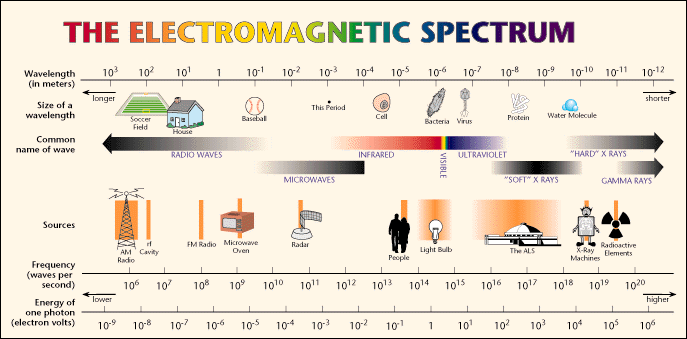
The length of a wave, its associated frequency (“wavelengths” or “cycles” per second) and energy determine its usage (see Figure 1).

Figure 1: The Electromagnetic Spectrum


Source:
http://galileo.phys.virginia.edu/classes/USEM/SciImg/home_files/introduction_files/EMSpec.gif
  1. Radio waves are relatively long, with wavelengths from 1,000 metres (1 km) to 10 cms, and frequencies from 3 kilohertz (3,000 cycles per second) to 3 gigahertz (GHz) or 3 billion cycles per second for the shortest, sometimes also called microwaves. (There are longer waves, e.g., electric power, of several km.)
  2. Microwaves in the centimetre and millimetre range can have frequencies up to 300 GHz. There is an overlap in terminology depending on use; microwaves for cooking use several hundred watts of electricity at RF wavelengths of about 32 cms (915 MHz) and 12 cms (2.45 GHz). Microwaves from low-powered devices of a few watts at these frequencies are used for communications, and emit insignificant heat.
  3. Infrared waves are smaller, and are felt as heat, e.g., from lamps and infrared grills used for cooking. Higher infrared bands used for communications in remote control devices and for imaging/night vision have no heating effect.
  4. Wavelengths between 700 and 400 nanometres (about 430 to 750 terahertz or THz) form the visible spectrum from red to violet, combining to form white light. For example, we perceive wavelengths of about 635-700 nm (430-480 THz) as the colour red.
  5. Shorter wavelengths form ultraviolet rays, of which those around 380-280 nm cause sunburn. Sunlight at sea level comprises about 53 per cent infrared, 44 per cent visible light, and 3 per cent ultraviolet rays.
  6. Yet smaller waves are classified as X-rays, and the smallest as gamma rays, both used in medical and industrial imaging.

The sweet spot in the RF spectrum for telephony and the Internet

For telephony and broadband, lower frequencies (700-900 MHz) are most cost-effective, as they traverse long distances without attenuation, penetrating walls and foliage. Radio waves in the atmosphere are affected by water vapour and ionisation, as well as events such as solar flares with bursts of X-rays. Depending on temperature, moisture, etc., radio waves may be absorbed, refracted, or reflected in the atmosphere, and by hills or other obstacles. Low frequency waves penetrate buildings and trees, and curve over slopes. Higher frequencies are more absorbed or reflected by the atmosphere; they are also more attenuated by distance and rain. Networks at lower frequencies require fewer towers than at higher frequencies.

What are 2G and 3G?

These signify different stages of technological development, starting with 1st Generation (1G) analog wireless in the 1980s, e.g., in car phones. 2G (2nd Generation) began in the 1990s with the digital wireless GSM standard for mobiles, extending to other standards, e.g., CDMA. 3G (3rd Generation) has faster data speed and greater network capacity.

What is 2G/3G spectrum?

There is no difference in the spectrum; only the convention of government regulations and harmonisation between countries by the International Telecommunication Union (ITU) earmark wavelengths for different applications. Both 2G and 3G can and do work at 800-900 and 1800-1900 MHz.

Combined with the advantages of prices dropping as volumes rise, one estimate puts 3G coverage with 900 MHz at 50-70 per cent lower cost than at the designated 2.1 GHz. 3G networks using 900 MHz (“2G spectrum”) exist in Finland, Iceland, Australia, New Zealand, Thailand, Venezuela, Denmark and Sweden, and countries like France encourage 2G networks to upgrade to 3G services.

Spectrum allocated for 2G and 3G by various countries is at Figure 2; the current and proposed allocation in India is shown below.


-->
* Existing # Proposed BWA: Broadband Wireless Access
[For details on 2G GSM & CDMA in November 2009, see: http://mobile.broadbandindia.com/2009/11/complete-2g-spectrum-allocation-info.html.

For proposed 3G and BWA auction bands, see:
For National Frequency Allocation Plan 2008: (Care - ~ 67 MB!)

This shows India’s dearth of spectrum for public use because of government and defence allocations. We need innovative methods to maximise capacity given our needs, limited landline networks, and the relative costs. (For details on the chart, please see: http://www.umtsworld.com/technology/frequencies.htm)

For example, China has allocated 250 MHz in the 800/1800 MHz bands. By not charging auction fees and spectrum charges, ubiquitous networks were built at lower cost with high capacity. These result in lower costs for users and higher productivity. With its focused approach, China also developed its own standard (TD-SCDMA).

India’s spectrum allocation is burdened with short-term revenue collection for the government, and a shortage mentality. There is apparently insufficient clarity on spectrum usage for ubiquitous broadband/telephony as in other countries, let alone more ambitious targets, such as developing an Indian standard.

Our policies could address the requirement for enhanced coverage/capacity at low cost to make services available everywhere at reasonable prices. Innovative approaches to spectrum management could help get these, through:
  1. Technology-neutrality: the UK and Norway have not restricted the use of recently auctioned spectrum to any technology.
  2. A focused strategy for service delivery at low cost, as in China.
This needs a combination of methods, e.g., along with technology-neutrality, (a) data-base driven, shared spectrum usage, under trial in the US, (b) “Cognitive Radio”, whereby smart devices sense available channels for dynamic, non-conflicting use in unlicensed spectrum bands, (c) incentives for rural broadband delivery, e.g., by subvention of fees and government charges, with (d) subsidies.

                                                      shyamponappa at gmail dot com


Footnote - Added later: May 26, 2013

1 What is Spectrum?


A more detailed explanation requires an understanding of the interrelated concepts of energy, work, and force, which are explained below.  Those who are not interested in technical details are advised to skip the box below to the paragraph with the diagram.

Energy, Work, & Force

Energy is the capacity to do work.  More precisely, it is the state or property of a system that enables it to perform work.  Work is defined as the change in position of an object, or of the state of an object or another system in motion or at rest through a transfer of energy to it, e.g., its temperature, which is a measure of the random motion of the particles comprising that system, or of the amount of light (i.e., radiant energy) or chemical energy in it, or its state of motion or rest.

Work is done through the application of force, the expending of any form of energy.  The major forms of energy are: electromagnetic radiation -- including RF spectrum, light, gamma rays, x rays, and so on; electrical energy; thermal energy or heat; mechanical energy; chemical energy; nuclear energy; sound energy; and gravitational energy.  Force is any influence that produces change in an object's or system’s state of motion or rest, or in its internal state.  Force has both direction and magnitude.  There are four known “fundamental forces” or “interactions” in physics:

- Gravitation, which affects all objects with mass.  Every object exerts a gravitational force on all other objects.  It is the weakest interaction, operates over infinite distances, and governs the structure of the universe. 

- Weak interaction, which affects all particles, and operates only at very short range.  It acts at the subatomic scale of atomic nucleii.

- Electromagnetic interaction, which affects all particles, has infinite range like gravity, and is much stronger than both gravity and weak interaction.  This form of interaction is responsible for the attractive or repulsive forces between electrical charges.

- Strong interaction, which affects subatomic particles called hadrons, which are themselves made up of quarks.  This type of interaction binds the nucleons in the nucleus of all atoms with the strongest force, operating at very short range.

These interactions hold particles together and organize them into complex objects (http://keyhole.web.cern.ch/keyhole/theory/main-5.html).  For details on the fundamental forces, see http://hyperphysics.phy-astr.gsu.edu/hbase/forces/funfor.html; for more about electric and magnetic charges and fields, see http://en.wikipedia.org/wiki/Electric_charge.


Electromagnetic radiation is pure energy without mass, and consists of waves of electrical and magnetic energy (see diagram below). 


These waves consist of a stream of photons, which are packets of energy that can be thought to behave like waves.  The energy in a stream of photons determines what kind of wave it is, i.e., whether they are light waves that we see as visible light, or radio waves or X-rays that are invisible.  This energy also determines the effect the photons have when they come into contact (interact) with particles of matter.

What Gives Rise To EMR?

All matter consists of atoms, which consist of mostly empty space.  Atoms are made up of negatively charged electrons revolving around a nucleus at the centre, which comprises positively charged protons and neutrons with no charge.  For example, a hydrogen atom has one proton and one neutron in its nucleus, and one electron in orbit.  The atom is 100,000 times the size of the proton.  This means if the nucleus of the atom were enlarged to the size of a tennis ball (6.5 cm), its electron would be at a distance of 6.5 km away; hence the mostly empty space. 

When energy is absorbed by an atom, one or more of its electrons shifts to a more distant, higher-energy orbit around the nucleus.  When the electron returns to its original level of orbit, energy is released as EMR and/or in some other form/s.  Depending on the material of the atom and the amount of energy released, the energy takes the form of heat, light, EMR, or other radiation such as X-rays or gamma rays.

SP
May 26, 2013