Showing posts with label Apple. Show all posts

Friday, May 5, 2023

Aiming For The High Road


Government's policies can either enable or limit our prosperity.

Shyam Ponappa  May 4, 2023

There are very divergent views about India’s economic prospects.  Some perceive great promise, while others see big government and unclear strategy.
 
The upbeat take is that investors who put substantial capital into China in its early growth phase are finding patterns mirrored in India that encourage their investment (An updated perspective on India, Business Standard, April 17, 2023). These investors are looking to limit or reduce new investments in China, and, among emerging markets, India is promising with the capacity to absorb large investments. Factors such as Apple’s exports of $5 billion in its first year support this, as does recent enthusiasm about India’s building logistics and effecting a digital transformation. The expectation is that annual growth will be over 6 per cent, and that gross domestic product/capita may grow from $2,500 to $5,000 in six to seven years.
 
A more downbeat view is that India has lost opportunities and made misplaced choices with growth coming from government spending and seat-of-the-pants strategies (Rolling the dice on growth, Business Standard, May 3, 2023). This has led to a constrained, uncompetitive private sector hobbled by disabling regulations, inadequate and unreliable infrastructure (notwithstanding high investment, on which more later), limited capital access, tariff barriers, an inappropriate and ineffective educational approach for employability and improving skills, and impoverishment through electoral handouts to much of the population. Instead of structural changes to provide lower cost infrastructure and efficient governance, the government chose corporate tax cuts to spur growth.
 
The fact is that while India is still in a sweet spot because of its economic resilience, momentum, favourable demographics (although largely unutilised), and improving productivity (1), growth in this decade is likely to average under 6 per cent annually. (See chart).
 

India will continue to outpace global average growth rates of real GDP and real per capita GDP from 2023 to 2030
                                                                                                                     (% change y/y)

 
Some data support this view, such as skewed consumer demand and delayed projects. Consumer demand is stronger at the high end, but weak at the lower end. Infrastructure project delays in March 2023 were reportedly the highest since 2004. These include nearly 57 per cent of projects over Rs 150 crore, resulting in cost escalation of over 20 per cent, amounting to half this year’s capital expenditure budget. 

Presumably this problem is reflected in the Gati Shakti National Master Plan. When public access is permitted, it will be interesting to know about the project management and coordination processes for timely execution, given its roots in a Project Management Institute report.


Higher growth of 8 per cent or above requires more structural change. These begin with policies that (a) provide reliable infrastructure that is affordable, (b) improve capital access, and (c) eliminate “tax terrorism”. Facilitating productivity through infrastructure everywhere would enable more people, including more women and young people, to participate and contribute. 

The next level of productivity improvement requires much deeper change. These extend to assuring a sense of security with law and order, access to meaningful education and skill building, deep changes away from “extensive” agriculture to an intensive, informed approach that is productive and sustainable. A critical prerequisite is cohesive, unifying leadership that inspires cooperation and inclusion.  Regarding better infrastructure, the following observations indicate possible ways to improve: 
 
Road Construction: New roads are being built at a furious pace.  However, two problems hamper our logistics despite the enormous sums spent. One is project delays. The other, more serious issue is the rapid deterioration of roads. While heavy rains do aggravate the problem, the underlying reasons are the quality of construction and lack of timely maintenance, made worse by undue emphasis on the value of contracts and quick implementation. Countries with equally severe weather variations build and maintain better roads. An expert with experience in America and India asserts that the reason is not enforcing requisite standards, quoting John F Kennedy that it is the roads that built America’s wealth. (2) This need for adherence to standards extends to many areas, and would transform our quality and competitiveness. It does not, however, lend itself to big targets and bragging rights for electoral purposes.
 
Communications – 4G, 5G and Beyond: If there were fast, reliable 4G-level connectivity countrywide, and if most people got access to these services, there would likely be a productivity revolution.  It would take much more than just connectivity: Development of content, technology choices and organisation are required to increase beneficial use exponentially. For example, content is needed for agricultural transformation to intensive cultivation, workplace skills and manuals, or K-12 education.
 
For the middle-mile and second-last mile, until the current blitz for BSNL 4G wireless, our policies emphasised fibre.  Widespread fibre-to-the-home is unrealistic in India because of the cost. The way out is high-speed wireless for middle-mile and second-last mile (backhaul), and for last-mile (Wi-Fi and cellular). We need enabling policies for these.
 
Another technology issue is 4G and 5G.  South Korea, leading in 5G, is the exemplar of the “5G fallacy” of getting five-fold speeds after $20 billion in network upgrades, instead of the desired 20 times speeds.  South Korea has nine cities of more than a million people, 42 between 100,000 to 1 million, and 77 between 10,000 to 100,000. They have 215,000 base stations of which only 2 per cent are 28 GHz, covering 45 per cent of their population. India has 48 cities of over 1 million, 405 with 100,000 to 1 million people, and 2,500 with 10,000 to 100,000 people.  We have 102,000 base stations compared to South Korea’s 215,000, and would need many more at unaffordable cost for blanket coverage. What we need instead is high-speed 4G or Wi-Fi, using wireless 60 GHz and 70-80 GHz for the middle-mile, with 6 GHz Wi-Fi for the last mile (in addition to existing Wi-Fi at 2.4 and 5 GHz).
 
One more requirement is technology organisation: Shared networks versus single-operator networks.  Shared neutral host networks (NHNs) are the most efficient, while active sharing by operators costs 70 per cent less per user in an Indian case study. (3) 

It is the government’s choice of policies that can help us on the high road.


Shyam (no space) Ponappa at gmail dot com

1: For details, see: “Productivity Growth in India: An Empirical Assessment”, RBI Bulletin January 2023.

https://rbidocs.rbi.org.in/rdocs/Bulletin/PDFs/02ART19012023C2BCA396B632479BBDD5485D89FDEEF4.PDF

and

Page 10: https://www.imf.org/-/media/Files/Publications/WP/2023/English/WPIEA2023082.ashx


2: https://www.nbmcw.com/article-report/infrastructure-construction/roads-and-pavements/why-do-many-roads-constructed-in-india-fail-prematurely.html  

Prof. Prithvi Singh Kandhal has drafted standards for the Indian Roads Congress, and was formerly at the National Centre for Asphalt Technology at Auburn University in Alabama.


3. https://www.researchgate.net/publication/368772499_Techno-Economic_Assessment_of_5G_Infrastructure_Sharing_Business_Models_in_Rural_Areas

Shruthi K.A. Kumar and Edward J. Oughton


Thursday, August 6, 2020

Configuring India's Digital Ecosystem


Policies must favour consortiums of local players - for operators with a government stake, and for manufacturers/system integrators with market access conforming to WTO rules.
Shyam Ponappa    |   August 6, 2020 
Two developments highlight the need for government to sponsor consortiums to build India’s digital ecosystem:
  • Facebook’s announcement in April to invest $5.7 billion in was momentous. In a slowing economy, Reliance Industries raised an incredible $20 billion with a cascade of foreign investments combined with a rights issue. This “consortium” makes Reliance debt-free, besides providing the capital and capacity to dominate communications in India.
  • India’s digital ecosystem’s dependence on China and on increasing imports underlines the imperative for corporate India to come together in a national endeavour that must succeed.

The Jio factor
Overwhelming dominance rarely benefits the public interest, even if the pricing starts incredibly low. Developed markets frown on monopolistic dominance, despite there being giants such as Microsoft, Google, Apple, Amazon, and Facebook.1
Discounting tall talk, India’s communications sector now has these upbeat expectations, along with a slew of old negatives, particularly the debt- and tax-burdened, fragmented other operators together with recalcitrant policies. Government-imposed charges and tax battles burden our operators, rendering them unable to compete.
How have Jio’s moves affected the public interest? With both benefits and detriments. The negative fallout from sectoral debt from auctions and crippling government levies, and a price war, has been unsustainably low tariffs. A positive effect is that data traffic increased greatly because of the low tariffs. Yet, the results are damaging: For service providers because of insufficient profits, for the market because it constrains quality and growth, and, therefore, for consumers in the short and long run. Service levels are compromised by resource constraints (dropped calls, slow speeds), and because of under-served customers — both in existing and the unserved markets in India. Data traffic may have increased simply because more people watch more rubbish in video form, whereas service providers need the wherewithal to invest, to improve and extend coverage, as well as to design constructive educational, skill-building, medical services, and other enhanced interactive services for users’ genuine benefit. In that sense, traffic as a measure of user benefits can cut both ways.
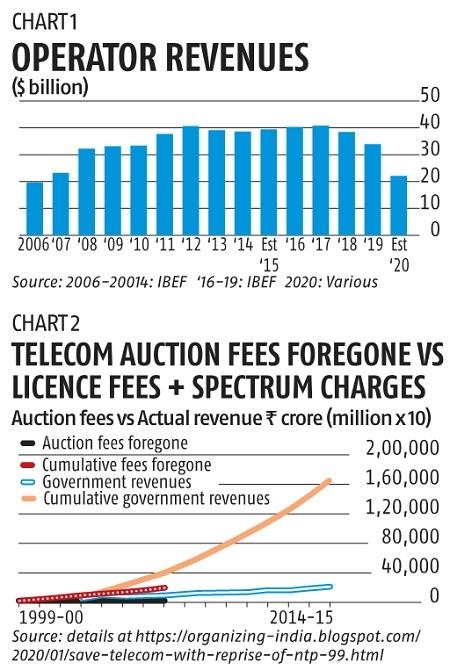
Apart from data, two other aspects merit consideration: Operator revenues, and government collections (licence fees, auction charges, and taxes). Operator revenues grew strongly from mid-2003 through FY2012, flattened for five years (FY2013-17), then declined after FY2017 (see Chart 1).

Barring additional charges, government revenues reflect this decline, leaving these lingering questions:
  • Does the declining trend serve the public interest?
  • What is the opportunity cost of disruption and deprivation of services?
A third issue requires action: How do we improve our digital prospects? Note that government collections from licence fees and spectrum charges rose steadily from FY2004, so that cumulative revenues far exceeded auction fees foregone (Chart 2). Corporate taxes were in addition to this.
Thereafter, government collections flattened, then declined (barring retrospective charges), as did taxes. This calls for policy intervention to enhance services, thereby increasing revenues and government collections. Straightforward adoption of global norms for wireless in 60GHz, 70-80GHz (V-band and E-band) and unused UHF (500-700MHz) restricted to operator use will help.2 So will giving up the farce of reviving BSNL/MTNL, including the hopelessly snaggled VRS, and the botched tenders (‘Most of it to Huawei?’ ‘No, Ericsson and Nokia.’ ‘Alright, 10 per cent to domestic suppliers.’ ‘No, all of it to domestic suppliers…’).
Competition for Services
A way to nurture balanced competition in services is for the government to create a consortium with a minority anchor, bringing financial, technological, and delivery capability to compete with Jio’s dominant platform.
Reliance Industries Chairman Mukesh Ambani calls for doing away with 2G; Airtel Chairman Sunil Mittal calls for supportive policies, and repudiating old battles such as contention over the adjusted gross revenue (a 15-year battle won in lower courts, lost in the Supreme Court), and reducing exorbitant charges. The government can change policies to achieve these. It can stop predatory practices, and facilitate this consortium. BSNL/MTNL can be genuinely supported to be the government anchor in the consortium with a minority stake, with golden-share national security, public- and minority-interest responsibilities through appropriate legislation. Airtel could be the lead, with others participating, including foreign players.

Equipment Consortium
Fragmented suppliers and system integrators also need a consortium for collaboration. While multinational vendors dominate, dependence on imports and China is untenable for our increasing and strategic requirements. Absent enabling policies, Indian manufacturers have to succeed offshore to sell within the country. Why do such things happen? Many reasons, starting with the holdover of colonial mindsets even of those who want to rewrite history, which treat the government — whoever is in power — as the colonial/feudal overlord, and the people as serfs with a vote, whose weaknesses can be pandered to for electoral victory. This imposes a zero-sum framework—the government versus the rest (Us versus Them).
In reality, the situation need not be zero-sum, as evidenced by past service growth and government collections through revenue sharing, compared with what might have been if auction fees were enforced: Bankruptcies and no services.
The prerequisites are (a) policies framed to provide access to local manufacturers and service providers conforming to WTO requirements; (b) their market access through continuing orders; (c) their collaboration to supply, install, and facilitate operations and maintenance of requisite equipment.
If these were made possible, domestic suppliers could meet a significant share of India’s communications needs. This requires emulating the Huawei model — easier said than done!3
The Union and state governments need to understand these components, and execute them from a national perspective, without bombastic rhetoric, politicking, fund-raising for elections, and so on. Policies must incentivise coordinated action; orders have to be winnable by including criteria for development of domestic capacity to conform to the World Trade Organization rules; and execution has to be first rate (on time, high quality). Digital communications will drive many aspects of all sectors. Our policy-makers must stop dithering and help us prepare effectively.

Shyam (no space) Ponappa at gmail dot com
1. For issues about competition laws in India, see: Amber Sinha & Arindrajit Basu, April 30, 2020:
"Analysis: Reliance Jio-Facebook deal highlights India’s need to revisit competition regulations"

Thursday, May 3, 2018

The Huawei Pointer


Taking a cue from Huawei.

Shyam Ponappa  |  May 3, 2018

Huawei has an awe-inspiring record of drive, perseverance, fortuitous circumstances, good strategy, execution, and success. A Chinese communications company founded in 1987 in Shenzhen by a former army engineer, Ren Zhengfei, Huaweiis now a legend. By 2012, it overtook industry leader Ericsson in global revenues. In 2017, its revenues were over $90 billion, two-thirds from outside China.  It also has a significant and growing presence in India. How did they do it?
Part of Huawei’s mystique stems from its outstanding founder and its driven work culture. This may be unique and difficult to replicate, but it is a byword for hard-charging Chinese high-tech. A meme that epitomises the culture is “9-9-6” — that is, for 9:00 am to 9:00 pm, 6 days a week. Can factors driving its success be adopted at the policy level and in enterprises in a democracy?
My previous column addressed the hollowing out of our manufacturing and other abilities. My suggestion is to replace obstructive policies with others that facilitate building infrastructure and local capacity, especially in growth areas. The example of Huaweiprovides a pointer. Perhaps some of what we learn can be applied at the governmental and the corporate levels.
Reports suggest these key factors in its success:
— Strong leadership with a sense of purpose: A customer-first attitude. There’s an anecdote of the founder being willing to meet any customer, but ignoring a potential investor by delegating to a colleague a meeting with a Morgan Stanley team, led by Chief Economist Stephen Roach.
— Broad employee ownership: In 2014, 84,000 employees out of 150,000 owned stock along with the founder, who owned only 1.4 per cent.2 They share an understanding that while an IPO would enrich some, the majority would lose their motivation. The essential requirements are hard work and dedication.
— Government support: Huawei grew revenues by building market share in China to become a national champion, then got support from the China Development Bank. Initially for $10 billion, it is now $30 billion.3 Building networks in Africa and Latin America, and low prices helped win deals in Europe. Mr Ren himself has said that without policy support, Huawei would not exist.
— Its unique culture and organisation: From inception, the founder was passionate about management, and about adapting methods and organisation. For instance, Huawei devised a top management model of a rotating CEO among three top executives, each of whom leads for six months, modelled on a flight of geese that change their order in arrowhead formation.4 Mr Ren is the mentor and coach. In March 2018 there was a change to a rotating Chairman position.
(The founder’s daughter, Meng Wanzhou (aka Sabrina Meng) is the Chief Financial Officer, and holds one of four vice-chair positions. His son Ren Ping works for a subsidiary providing reservations and trade show support.)
Another instance is Huawei’s Integrated Financial Services transformation program, which Ms Meng led since 2007. It was an eight-year partnership program between Huawei and IBM to develop data systems and resource allocation rules, operations, process optimisation, and internal controls.


— Huawei reportedly invests 10 per cent of annual revenues on Research & Development.

— Huawei also emphasises “the power of thinking”. Executives are urged to read beyond their domains, and books are everywhere.
These factors enable Huawei to solve problems for clients in diverse situations. Examples:
— In its early days, networks were at risk from rats gnawing through circuitry in desert and rural areas in China. Multinational vendors did not consider this their problem and left it to their customers. Huawei, by contrast, treated it as their own problem, and developed sturdier equipment and materials such as chew-proof wires. This experience later helped gain large accounts in the Middle East where customers faced similar problems.
— Other extreme environmental conditions have been addressed, such as base stations installed at high altitudes (at 6,500 metres on Mt Everest), or in the Arctic. These experiences helped a dedicated and committed workforce gain more clients. For instance, when expanding their 3G market in Europe, Huawei found that clients expected “base stations to be more compact, easier to install, greener, and more energy efficient, while offering wider coverage”. To cater to these needs, Huawei developed distributed base stations that could handle both large and small private networks, making them cheaper to deploy, which became popular with European carriers.
— The employee-ownership arrangement and associated dedication enable planning for the long term, as with the Chinese government. Huawei plans for 10 years, whereas competitors have to contend with quarterly financial considerations.1
Carriers buying Huawei network equipment get significant discounts in smartphones. Focusing on new technology not controlled by the giants of 3G such as Qualcomm, Ericsson, and Nokia, enabled Huawei to develop 4G, which is much faster and ideally suited for updating-apps, to the point that it competes with Samsungand Apple. Undercutting competitors has enabled it to sell to carriers, and its depth of products and technology has enabled it to meet customer needs, displacing competitors.
Huawei’s R&D Centre in Bangalore established in 1999 is its largest outside China, and it has offshore Global Network Operating Centres in Gurgaon and Bangalore, besides Romania and Nigeria. These GNOCs run networks not only in India but across the globe for a number of operators, offering managed network services integrating a range of equipment at low cost. With its market strength, depth of products, and access to funds, Huawei is likely to control network services in India and much of the world from now on through the 5G evolution cycle.
The only way for competition other than in-house NOCs in India is if the Government of India develops end-to-end supportive policies, transcends election cycles, and sponsors a consortium comprising a major transnational anchor, a system integrator, and local design and production wherever technological opportunities arise.


Located within Huawei’s Research and Development (R&D) campus in Bengaluru, the GSC is currently home to over 1,000 engineers, network operations specialists and support staff.


Shyam.Ponappa@gmail.com
4. Belasco, James A. Stayer, Ralph C. (1993). Flight of the Buffalo. New York, NY: Warner Books.