Showing posts with label 2G. Show all posts

Friday, November 7, 2014

(Fixing) India's Systemic Flaws


We need breakthroughs in tax claims and coal and spectrum allocation, but most of all, in societal accord


On the face of it, several developments augur well for the economy. But major systemic flaws persist that must be overcome.

Some gains have resulted from Prime Minister Narendra Modi's direct selling and "heavy lifting", as in eliciting Japanese investments. Others, such as the drop in petroleum and commodity prices, are attributable to extraneous factors. The positive developments that seem to be coalescing into a glow on the economic horizon include:
  • The revival of stalled projects.
     
  • A reduction in raw material costs, with oil prices now well under $90 a barrel.
     
  • Significant investments from Japan's SoftBank in Snapdeal and Ola; other significant investments and announcements in e-commerce, for example, Flipkart and Amazon.
     
  • The implementation of electronic toll collection (ETC) on our highways. Introduced between Ahmedabad and Vadodara on National Highway 8 (NH-8) in 2013, the ETC became available last week between Delhi and Mumbai on NH-8. It is expected to be available on all national highways in the next two months. Vehicles with prepaid tags can drive through without slowing down, whereas until now, all vehicles had to stop to pay tolls. The productivity gains will be enormous, with fuel savings across toll stations estimated at Rs 60,000 crore (see BS, October 30, 2014 and BS, October 31, 2014 for details).

But all is not entirely well. The fiscal deficit is at 80 per cent of what was budgeted for the full year; there was a decline in projects completed in the September quarter; and there is uncertainty about growth rates.

The real issue, though, is that major systemic flaws persist, resulting in growing economic and operating constraints. There are the problems of retrospective tax claims, of coal allocation and of spectrum allocation. In the societal dimension, there are continuing indications of disharmony, resulting in wariness and insecurity about whether we have a unifying or divisive top leadership, let alone rank and file. Proceeding with business as usual with the present ineffective ways will lead to continuing and increasingly overwhelming detrimental effects. Each of these areas needs breakthroughs to achieve convergent, synergistic results.

Coal

Over 60 per cent of stalled projects tracked by the Performance Management Group in the Cabinet secretariat are power projects, held up because coal is not available. Coal-mining rights are to be auctioned on the lines of spectrum. What are the likely outcomes?

While the government was jubilant about funds collected from the auctions, this created enormous capital and operating constraints for the communications sector. This is because the Rs 1.05 lakh crore bid for spectrum became unavailable for network construction and operations, and the limited bandwidth available to each operator adds to costs and restricts delivery capability. Growth in network capacity has deteriorated to the point where we have higher levels of dropped calls in metros, with continuing poor broadband access countrywide. The effects on productivity are ruinous.

What can we expect from mining rights auctions? If the results are as for the spectrum auctions, we'll have high treasury collections, high life-cycle project costs affecting critical inputs like electricity, steel and aluminium, and a reduction in investment in mining operations and downstream manufacturing. These are logical outcomes: the consequence of higher costs is either higher prices, or financial under-recovery leading to collapse, and capital used for auctions is unavailable for investment. Instead, what we really want from the mining allocation is inexpensive electricity and efficient production of industrial materials, such as steel and aluminium.

The financial insolvency of our state electricity boards reflects the magnitude of the problem. Even the story of Gujarat's electricity distribution raises questions for the rest: Gujarat's average farm tariff is under Rs 1 a unit, compared with a non-farm tariff of Rs 4-5 (see "Farmers pay 56 paise per unit of electricity"*). The high cost of providing these connections is unviable with the low revenue of 56 paise a unit. This is why there is a backlog of about 400,000 farmers waiting for connections despite Gujarat's "surplus" of over 2,000 megawatts. Distributing electricity at such low rates is simply unsustainable, and the situation is much worse in states providing free electricity.

A possible way to approach this is to appoint two or three individuals with the integrity and competence to work with the government, industry and experts to develop an allocation plan. If this "beauty-parade" approach seems too utopian or academic for India, please be aware that this is precisely how land acquisition was actually done for the Calcutta Metro around 1982 after years of delay, and for part of the Bangalore Metro in 2006.

Spectrum

The spectrum constraints, meanwhile, show in the high levels of dropped calls because of congested lines, and the slow rollout of networks into rural areas. This slowness is because of the unfavourable economics: of high cost and difficult execution, with lower revenue potential. What we want from spectrum allocation is access to broadband networks at prices that will result in productivity gains. Instead, we have neither adequate broadband networks, nor sufficiently widespread access for productivity. A better solution is pooled networks with mandatory shared access on payment, with the government getting a share of revenues.

Ecosystems

Apart from inadequate infrastructure, logistics, finance and regulations, all of which must be well-orchestrated to achieve supportive ecosystems for investment and operations, the tax-claims fallout continues to undermine growth prospects. While the Vodafone problem may be finally resolved, the closure of Nokia's manufacturing facility in Chennai because of tax claims undercuts all the sales talk. Each sector needs a supportive ecosystem, integrated with the rest.

Social Disharmony

Above all, social disharmony seriously affects our capacity for collective action. Social coherence is essential for constructive development. The leadership's effectiveness in reaching out and inspiring constructive aspirations can help to harmonise and channel citizens towards desirable common goals. Such collective initiatives would reduce our fractiousness and infighting, making win-win outcomes more possible.

The solutions in all these areas need to be path-breaking, based on integrity, trust and bold, collaborative action. We have to learn these ways.


                                                                              Shyam (nospace) Ponappa at gmail dot com

*http://indianexpress.com/article/cities/ahmedabad/farmers-pay-56-paise-per-unit-of-electricity/

Comments (2):

  • karthikeyan
    Tax Havens can be created , for NOKIA alikes ?? :)
  • ashok
    The state of the power sector can make or break Make In India. Worthy of attention at the highest levels of government. 2. Whether spectrum or coal, the government can meet the industry half way by taking its entitlement as a revenue stream rather than an initial lump of capital.


Thursday, October 11, 2012

The Supreme Court Delivers


Now, the spectrum and licence issues need resolution

On September 27, 2012, the Supreme Court of India delivered the opinion of a bench comprising five Judges on the Presidential Reference regarding the auction of 2G spectrum.

Shyam Ponappa / Oct 04, 2012


The Supreme Court’s opinion on the Presidential reference* dismissed two preposterous claims. One is that it is beyond the ambit of Parliament and the government to formulate economic policies. The second is that the government must allocate resources only through auctions. It’s like the end of a self-destructive nightmare. True, our heedless kleptocracy as a society of rogue politicians, bureaucrats, defence personnel, and complicit citizens, led to this pass. Even so, the anarchic “destructionism” of these claims is as reprehensible as the kleptocracy they seek to tear down. Fortunately, the Supreme Court opinion rose above the populist clamour.

There’s still a mess to clear. The big picture is that the Supreme Court left its decision on spectrum auctions unaddressed. In matters of detail, some points need resolution based on facts. These are discussed below to dispel prevalent myths.


Myth 1: Auctions maximise govt revenues

“Auctions may be the best way of maximising revenue…”: paragraph 116 of the opinion. This contravenes the evidence after the National Telecom Policy -99 (NTP-99), that revenue-sharing maximises government revenues as well as public benefits. It also ignores the many auction failures.

Consider the evidence: auction revenues foregone were estimated at under Rs 20,000 crore for 1999-2007, because the sector was mired in losses and was unable to provide services effectively or pay those dues. By comparison, actual collections from revenue-sharing by March 2007 were more than double, at Rs 40,000 crore. Collections by March 2010 were Rs 80,000 crore. Current annual contributions to government revenues may be about Rs 18,000 crore on Adjusted Gross Revenues estimated at Rs 1,40,000 crore, plus taxes, amounting to perhaps Rs 36,000 crore.

Re public benefits, access to telephony grew from a few million users in 1999 to about 700 million today (excluding around 250 million shadow subscriptions).

An ameliorating caveat in paragraph 12 states: “…if the State arrives at the conclusion … that maximum revenue would be earned by auction of the natural resource in question, then that alone would be the process”, and this is expanded in paragraph 119:

“Where revenue maximisation is not the object of a policy of distribution, the question of auction would not arise. Revenue considerations may assume secondary consideration to developmental considerations.”

This has not prevented erroneous conclusions in the press that auctions are the only valid process, notwithstanding that the conditions stipulated in the order, eg, that government’s actions be “fair, reasonable, non-discriminatory”, were always operative, if not adhered to in instances of abuse, as in the 2G scam.

Myth 2: Maximum govt collections are in the public interest

Government collections as the public interest criterion may work for colonial powers extorting revenues from subject states, or possibly for utopias whose political economy is so balanced that such cross-subsidisation works. Developing economies like India presumably can and should seek the welfare of their people. The same populists crusading for maximum government collections accuse governments of corruption and waste. This doesn’t provide a coherent approach to infrastructure, where each capital-intensive sector is configured to deliver a specific service. For instance, the energy sector has to deliver power, while telecommunications must deliver communications services. Neither can be expected to deliver toilets or water. Yet, many well-intentioned people seem to nurture such irrational expectations.

The spectrum and broadband link


The first prerequisite for broadband is high-speed connectivity. The second is reasonably priced services. Our objectives are, therefore: (a) a broadband network, (b) available anywhere (c) at reasonable prices. Our networks are deficient, however, particularly in rural and semi-urban areas. A host of factors are responsible, ranging from limited public sector network rollout, combined with a private sector focus on the most lucrative urban centres, with incentives skewed to voice telephony. Applications need connectivity based on networks that require spectrum.

Problems and solutions

Consider an application like distance education. The need is for networks and services of high quality (followed by the additional requirement of content). What is apparent is that such applications cannot be effective without the connectivity. So we’re back to the need for networks, of fibre where feasible, and wireless elsewhere. This brings us back to the need for spectrum.


Reviewing facts

As regards the facts relating to the 2G judgment deserving review:
The solution the Supreme Court has not considered is that operators need only to use spectrum, for which they can be charged a fee. The evidence of widely available Wi-fi shows that innovation and usage thrive if spectrum is available. The Supreme Court, the government, and the public need to recognise that allocating spectrum to operators is only one way to use spectrum.

There need be no alienation of spectrum at all, if policies allow open access and charge fees. Then, spectrum could be used like any infrastructure network, eg, airports, highways, or rail, on payment of usage charges. The sharing could be in at least two ways. Operators could pool spectrum for collective use. For this, (i) regulations must allow pooling/active facilities sharing, and (ii) operators must agree on terms and procedures. Another way is for mandatory spectrum sharing using the database-driven systems being implemented in the US by Spectrum Bridge and Telcordia. Similar deployments are planned in the UK, the European Union, and in Singapore. The TV white space is shared because this range is available for sharing, and not because other bands cannot be shared.

There are immense societal costs of duplication in capital investments in multiple networks, including the last-mile spectrum access, of operators using dedicated networks with limited passive facilities sharing (such as towers), compared with the benefits of open-access to common networks, if policies changed. These would employ active facilities sharing (equipment, and not just construction) to reduce capital equipment, construction costs, energy for towers, carbon emissions from a more limited physical network, possibly reduced radiation from a rationalised network with small cells with lower-powered equipment, and the multiplier effect on the finite available spectrum.

Enormous productivity benefits could accrue through ICT applications in infrastructure such as smart grids for energy, transportation, education, healthcare, and government services, as well as many commercial applications.

The Supreme Court could also uphold contractual obligations, by discriminating against actual transgressors in the 2G spectrum allocation, while rehabilitating those who operated within the law.


shyam[no space]ponappa at gmail dot com 


http://supremecourtofindia.nic.in/outtoday/op27092012.pdf  Changed - corrected below


* RE: SPECIAL REFERENCE NO.1 OF 2012

[Under Article 143(1) of the Constitution of India]

SEPTEMBER 27, 2012

[S.H. KAPADIA, CJI, D.K. JAIN, JAGDISH SINGH

KHEHAR, DIPAK MISRA AND RANJAN GOGOI, JJ.]

supremecourtofindia.nic.in/pdf/SupremeCourtReport/2012_v9_pii.pdf  Changed - corrected below


Thursday, December 2, 2010

'Model T' - for Telecom


We need an initiative coordinated by the PMO that optimises both services and government revenues
Shyam Ponappa / New Delhi December 2, 2010

The 2G spectrum troubles give India an opportunity for clear thinking and purposive action for a significant impact on people’s lives. We (all stakeholders: operators, central and state governments and agencies, the media, opposition parties, PSUs and private corporations, and citizens) need to recognise that there are two distinct aspects to the wrangle: legacy problems and the way forward. The 2G controversy has to do with the truth and consequences of legacy actions. The way forward concerns our fundamental purpose, i.e. the delivery of effective and efficient communications services. What then must we do?

1. Past problems: Follow due process
Many commentators and sections of the public take a shotgun approach, demanding the cancellation of licences and auctioning confiscated spectrum. This is outside the purview of the law and will destabilise the sector and the economy, as will any arbitrary government action.
In a democratic society, there is a proper way to address these problems: through the due process of law, not summary judgements ending in figurative lynchings. There are contracts with operators, and we have to learn to respect and enforce the law. Use harsh penalties by all means, but only after (a) going through due process in establishing the facts, (b) provided there is evidence of culpable wrongdoing, and (c) the law calls for harsh penalties. If the law calls for a slap on the wrist, we need to change our laws for serious crimes, not resort to mob violence in the guise of righteous outrage.

2. Present and future needs: Approach needs with a sense of purpose

A different aspect of the predicament relates to how we can achieve improved communications infrastructure and services in India. This includes broadband Internet, voice telephony, TV and radio. We need a constructive approach encompassing services, hardware and software, instead of being mired in outmoded practices based on exclusive spectrum allocation, for example. Our focus has to be on our purposes/needs: ubiquitous access at a reasonable price. We need broadband for every household. How do we get it?

Capitalising on the low-margin model
The growth of mobile telephony provides a workable model. The graph below shows the rise in subscriptions with declining prices after the shift to revenue sharing in NTP ’99, together with reductions in revenue share percentages for licence and spectrum fees, and in the access deficit charge.


This is a good instance of Henry Ford’s low-margin, high-volume strategy for the Model T. To sustain low tariffs extending to broadband, we need to reduce extraneous levies. A Trai study of 2005 showed government levies on telecommunications in India were far in excess of China, Sri Lanka and Pakistan.*

The study also showed that licence fees from the original auctions would have amounted to Rs 19,314 crore through 2006-07. According to the CAG report, licence and spectrum fees with reduced levies actually amounted to Rs 40,169 crore by 2006-07, i.e. double the auctions; by March 2010, the figure was nearly Rs 80,000 crore.** Over a long period, reduced revenue share for licence and spectrum fees has resulted in explosive growth as well as higher government collections than auctions and high fees


Initiative by ministry or PMO?

Why can’t the communications ministry, the DoT and Trai effect this transformation? Recall the scope of NTP ’99 and the role of the Prime Minister’s Office (PMO) for these reasons:
- First, reduced short-term government revenues. In the long term, the revenue sharing in a vibrant sector far exceeds the auction take, as shown above. Recall that the primary motivation for the licence auctions of the 1990s and the spectrum auctions was collecting government revenues. Hence, the first criterion is the stance of the finance ministry and the government on revenue collection.
- A second criterion at the state level is also financial, for rights of way charges.
- Third is India’s approach to spectrum management. Spectrum use can be structured like road or rail networks, or oil pipelines, instead of being treated as exclusive property or usage rights. The difference in costs and benefits to society is staggering. It’s like the right to use daylight or the air we breathe. Visible light is a part of the same electromagnetic radiation, so if there is a charge for radio frequency spectrum, why not for visible light and/or the atmosphere? Rentiers might see this as an opportunity for revenues, but democracies surely must consider it against the public interest.
- Existing networks of various government undertakings, including PSU operators BSNL and MTNL, PowerGrid, Gail as well as private operators, could be managed as national assets, as described above for spectrum on payment for usage. This need not mean government control and administration, as there could be a consortium with government participation. There are compelling economic reasons for public access to spectrum and networks because of the drastic reductions in investment, with higher asset utilisation, environmental benefits from less redundancy, and reduced radiation from towers, as in one highway network instead of many.

The Opportunity


Even as the law takes its course on wrongdoings, we need a new “New Telecom Policy” on the lines of NTP ’99. This is essential for transformational changes in communications services, clearing up confused policies that are at cross-purposes, and extending to boundary domains in ICT. We should aim for “Model T” pricing with access for everyone. We need an across-the-board initiative to replicate the successful aspects of mobile telephony for broadband and other forms of communication (TV, radio). The PMO could orchestrate a workout with all stakeholders that builds in the benefits of shared network resources, including spectrum, with efficient, low-frequency spectrum for rural communications with much less capital investment.


Shyam (no-space) Ponappa at gmail dot com


Citations updated: June 30, 2019

* Study Paper on “Indicators for Telecom Growth”, Trai, Study Paper 2/2005: 

** “Performance Audit Report on the Department of Telecommunications, Ministry of Communications and Information Technology”,

Friday, March 5, 2010

Understanding Spectrum

Telephony and broadband need innovative spectrum management


Shyam Ponappa / New Delhi March 4, 2010

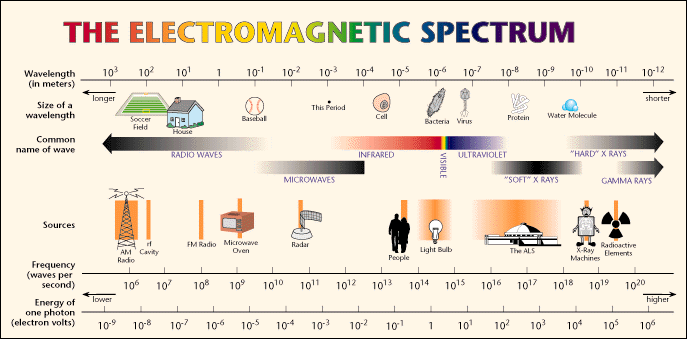
Twenty years ago, “spectrum” implied the colours of the rainbow. Now, we understand that spectrum also relates to mobile phones. We encounter spectrum daily, in TV remote controls, microwave ovens, even sunlight. So, what exactly is spectrum, and how do government and commercial decisions on this scientific phenomenon affect public facilities and costs?

“Spectrum” is short for “electromagnetic spectrum”, the range of radiated energies that envelop the Earth and extend through space. This electromagnetic radiation (EMR) is primarily from the sun, and secondarily from the stars/cosmos, radioactive elements in soil, rock and gases.  

[Added later - May 26, 2013:
For more details on what spectrum is, please see the footnote.1  The rest of the article is on the uses of spectrum.]

One section of EMR is visible light; another is radio frequency (RF) spectrum. There are many other “wavelengths” in EMR with different characteristics and effects, such as infrared and ultraviolet rays. All countries have the same RF spectrum in equivalent areas.

How is spectrum used?

The length of a wave, its associated frequency (“wavelengths” or “cycles” per second) and energy determine its usage (see Figure 1).

Figure 1: The Electromagnetic Spectrum


Source:
http://galileo.phys.virginia.edu/classes/USEM/SciImg/home_files/introduction_files/EMSpec.gif
  1. Radio waves are relatively long, with wavelengths from 1,000 metres (1 km) to 10 cms, and frequencies from 3 kilohertz (3,000 cycles per second) to 3 gigahertz (GHz) or 3 billion cycles per second for the shortest, sometimes also called microwaves. (There are longer waves, e.g., electric power, of several km.)
  2. Microwaves in the centimetre and millimetre range can have frequencies up to 300 GHz. There is an overlap in terminology depending on use; microwaves for cooking use several hundred watts of electricity at RF wavelengths of about 32 cms (915 MHz) and 12 cms (2.45 GHz). Microwaves from low-powered devices of a few watts at these frequencies are used for communications, and emit insignificant heat.
  3. Infrared waves are smaller, and are felt as heat, e.g., from lamps and infrared grills used for cooking. Higher infrared bands used for communications in remote control devices and for imaging/night vision have no heating effect.
  4. Wavelengths between 700 and 400 nanometres (about 430 to 750 terahertz or THz) form the visible spectrum from red to violet, combining to form white light. For example, we perceive wavelengths of about 635-700 nm (430-480 THz) as the colour red.
  5. Shorter wavelengths form ultraviolet rays, of which those around 380-280 nm cause sunburn. Sunlight at sea level comprises about 53 per cent infrared, 44 per cent visible light, and 3 per cent ultraviolet rays.
  6. Yet smaller waves are classified as X-rays, and the smallest as gamma rays, both used in medical and industrial imaging.

The sweet spot in the RF spectrum for telephony and the Internet

For telephony and broadband, lower frequencies (700-900 MHz) are most cost-effective, as they traverse long distances without attenuation, penetrating walls and foliage. Radio waves in the atmosphere are affected by water vapour and ionisation, as well as events such as solar flares with bursts of X-rays. Depending on temperature, moisture, etc., radio waves may be absorbed, refracted, or reflected in the atmosphere, and by hills or other obstacles. Low frequency waves penetrate buildings and trees, and curve over slopes. Higher frequencies are more absorbed or reflected by the atmosphere; they are also more attenuated by distance and rain. Networks at lower frequencies require fewer towers than at higher frequencies.

What are 2G and 3G?

These signify different stages of technological development, starting with 1st Generation (1G) analog wireless in the 1980s, e.g., in car phones. 2G (2nd Generation) began in the 1990s with the digital wireless GSM standard for mobiles, extending to other standards, e.g., CDMA. 3G (3rd Generation) has faster data speed and greater network capacity.

What is 2G/3G spectrum?

There is no difference in the spectrum; only the convention of government regulations and harmonisation between countries by the International Telecommunication Union (ITU) earmark wavelengths for different applications. Both 2G and 3G can and do work at 800-900 and 1800-1900 MHz.

Combined with the advantages of prices dropping as volumes rise, one estimate puts 3G coverage with 900 MHz at 50-70 per cent lower cost than at the designated 2.1 GHz. 3G networks using 900 MHz (“2G spectrum”) exist in Finland, Iceland, Australia, New Zealand, Thailand, Venezuela, Denmark and Sweden, and countries like France encourage 2G networks to upgrade to 3G services.

Spectrum allocated for 2G and 3G by various countries is at Figure 2; the current and proposed allocation in India is shown below.


-->
* Existing # Proposed BWA: Broadband Wireless Access
[For details on 2G GSM & CDMA in November 2009, see: http://mobile.broadbandindia.com/2009/11/complete-2g-spectrum-allocation-info.html.

For proposed 3G and BWA auction bands, see:
For National Frequency Allocation Plan 2008: (Care - ~ 67 MB!)

This shows India’s dearth of spectrum for public use because of government and defence allocations. We need innovative methods to maximise capacity given our needs, limited landline networks, and the relative costs. (For details on the chart, please see: http://www.umtsworld.com/technology/frequencies.htm)

For example, China has allocated 250 MHz in the 800/1800 MHz bands. By not charging auction fees and spectrum charges, ubiquitous networks were built at lower cost with high capacity. These result in lower costs for users and higher productivity. With its focused approach, China also developed its own standard (TD-SCDMA).

India’s spectrum allocation is burdened with short-term revenue collection for the government, and a shortage mentality. There is apparently insufficient clarity on spectrum usage for ubiquitous broadband/telephony as in other countries, let alone more ambitious targets, such as developing an Indian standard.

Our policies could address the requirement for enhanced coverage/capacity at low cost to make services available everywhere at reasonable prices. Innovative approaches to spectrum management could help get these, through:
  1. Technology-neutrality: the UK and Norway have not restricted the use of recently auctioned spectrum to any technology.
  2. A focused strategy for service delivery at low cost, as in China.
This needs a combination of methods, e.g., along with technology-neutrality, (a) data-base driven, shared spectrum usage, under trial in the US, (b) “Cognitive Radio”, whereby smart devices sense available channels for dynamic, non-conflicting use in unlicensed spectrum bands, (c) incentives for rural broadband delivery, e.g., by subvention of fees and government charges, with (d) subsidies.

                                                      shyamponappa at gmail dot com


Footnote - Added later: May 26, 2013

1 What is Spectrum?


A more detailed explanation requires an understanding of the interrelated concepts of energy, work, and force, which are explained below.  Those who are not interested in technical details are advised to skip the box below to the paragraph with the diagram.

Energy, Work, & Force

Energy is the capacity to do work.  More precisely, it is the state or property of a system that enables it to perform work.  Work is defined as the change in position of an object, or of the state of an object or another system in motion or at rest through a transfer of energy to it, e.g., its temperature, which is a measure of the random motion of the particles comprising that system, or of the amount of light (i.e., radiant energy) or chemical energy in it, or its state of motion or rest.

Work is done through the application of force, the expending of any form of energy.  The major forms of energy are: electromagnetic radiation -- including RF spectrum, light, gamma rays, x rays, and so on; electrical energy; thermal energy or heat; mechanical energy; chemical energy; nuclear energy; sound energy; and gravitational energy.  Force is any influence that produces change in an object's or system’s state of motion or rest, or in its internal state.  Force has both direction and magnitude.  There are four known “fundamental forces” or “interactions” in physics:

- Gravitation, which affects all objects with mass.  Every object exerts a gravitational force on all other objects.  It is the weakest interaction, operates over infinite distances, and governs the structure of the universe. 

- Weak interaction, which affects all particles, and operates only at very short range.  It acts at the subatomic scale of atomic nucleii.

- Electromagnetic interaction, which affects all particles, has infinite range like gravity, and is much stronger than both gravity and weak interaction.  This form of interaction is responsible for the attractive or repulsive forces between electrical charges.

- Strong interaction, which affects subatomic particles called hadrons, which are themselves made up of quarks.  This type of interaction binds the nucleons in the nucleus of all atoms with the strongest force, operating at very short range.

These interactions hold particles together and organize them into complex objects (http://keyhole.web.cern.ch/keyhole/theory/main-5.html).  For details on the fundamental forces, see http://hyperphysics.phy-astr.gsu.edu/hbase/forces/funfor.html; for more about electric and magnetic charges and fields, see http://en.wikipedia.org/wiki/Electric_charge.


Electromagnetic radiation is pure energy without mass, and consists of waves of electrical and magnetic energy (see diagram below). 


These waves consist of a stream of photons, which are packets of energy that can be thought to behave like waves.  The energy in a stream of photons determines what kind of wave it is, i.e., whether they are light waves that we see as visible light, or radio waves or X-rays that are invisible.  This energy also determines the effect the photons have when they come into contact (interact) with particles of matter.

What Gives Rise To EMR?

All matter consists of atoms, which consist of mostly empty space.  Atoms are made up of negatively charged electrons revolving around a nucleus at the centre, which comprises positively charged protons and neutrons with no charge.  For example, a hydrogen atom has one proton and one neutron in its nucleus, and one electron in orbit.  The atom is 100,000 times the size of the proton.  This means if the nucleus of the atom were enlarged to the size of a tennis ball (6.5 cm), its electron would be at a distance of 6.5 km away; hence the mostly empty space. 

When energy is absorbed by an atom, one or more of its electrons shifts to a more distant, higher-energy orbit around the nucleus.  When the electron returns to its original level of orbit, energy is released as EMR and/or in some other form/s.  Depending on the material of the atom and the amount of energy released, the energy takes the form of heat, light, EMR, or other radiation such as X-rays or gamma rays.

SP
May 26, 2013

Tuesday, September 8, 2009

Making Broadband Happen


There are opportunities to repeat the success of NTP '99 with 3G and Broadband Wireless Access

Let’s take stock of the Empowered Group of Ministers’ reported decisions on spectrum auctions for 3G and Broadband Wireless Access (BWA, aka WiMAX), and see what remains to be done.

To recap briefly:

  • There will be four bidders for spectrum designated for 3G, making for five operators per circle including MTNL or BSNL.
  • There will be three bidders for spectrum designated for BWA, making for four operators per circle including BSNL/MTNL.
  • The reserve price for a pan-India 3G license will be Rs 3,500 crore for 5 MHz (about $700 million).
  • The reserve price for a pan-India BWA license will be Rs 1,750 crore for 10 MHz (about $350 million).
  • Pre-bid conferences will be held in the next few weeks, leading to auctions in the next three months.

    Assessment

    1. There is one sound aspect to the decisions, while other aspects seem less so. The good one is limiting the operators to five per circle for 3G, and four for BWA. This signals an excellent, forward-looking approach aligned with best practices. A limited number of operators can have contiguous bands of spectrum. This will provide the freedom and incentive to build networks and offer services aggressively.

    2. As demand for spectrum exceeds supply, serious bidders may be excluded. The EGoM could remedy this and simultaneously address another problem, the issue of unused spectrum, through establishing policies for resale. Unused spectrum is akin to speculative property investments without development waiting for asset prices to rise before resale, or locked granaries when food supplies are low. As with land at favorable prices for setting up industries, access with development conditions maintained by the actual rule of law with real-time monitoring— no back-door deals, after-the-fact regularisation as with CDMA, or predatory or duplicitous behavior— will probably result in the greatest collective benefits.

    3. The EGoM should also explore spectrum-sharing, i.e., non-exclusive spectrum use on common carrier principles. A technically and commercially informed effort for shared usage could lead to optimised use of available spectrum. For this reason, it is important that consultations include companies like Ericsson, Nokia, Motorola and Qualcomm, and Internet service providers. It is also critical that the government's advisors include experienced Radio Frequency Engineers (RF engineers) who understand the capacity and limitations of radio waves, as well as IT and regulatory experts including the TRAI. These considerations are critical for informed decisions, and consultations should not be restricted to economic, financial, legal/regulatory, tax and accounting issues. Because of the potential conflicts of interest, it is advisable that technical expertise should be from outside/or in addition to the DoT/BSNL/MTNL.

    4. A third area for consideration is technology neutrality: unrestricted use for services delivered (within amended regulations). In other words, any communications service for voice, data or multimedia to be allowed on any spectrum band, with any equipment (2G, 3G…), using any technology.

    Removing technology restrictions will permit unconstrained service delivery, resulting in optimal spectrum usage. Currently, e.g., BWA can be used only for data transmission; 3G spectrum is meant for 3G equipment. In fact, different technologies can use the same frequencies. Radio waves can be propagated farther with less power at lower frequencies, resulting in lower costs. One estimate is that 3G at 900 MHz can be built at 60 percent lower cost than in the 2.1 GHz band.* However, there is also the issue of harmonisation: aligning with the way technology evolves globally, so that volumes and experience yield lower costs. Service providers should be able to choose spectrum use depending on markets, technology (present and future), regulation, and commercial logic.

    Instead of self-imposed restrictions on technology, our policies should seek to optimise usage of spectrum and technology for societal benefits through a network delivering voice, data and video. The present restrictions undermine project economics especially in sparsely-populated areas, whereas an ability to offer all feasible services is both reasonable and commercially compelling, as a basket or bouquet of services offers more to users, and service providers benefit from the efficiencies.

    Conclusions

    There are two sets of issues that deserve the EGoM’s consideration:

    1. Technology issues, and

    2. Pricing and regulatory issues.

    Technology and restrictions

    a) Voice over Internet Protocol: Enabling VoIP in line with international practices will benefit users, but will raise issues of protecting BSNL/MTNL's revenues. This needs constructive resolution; however, it should not be at the cost of the public interest in prohibiting VoIP [while beyond the scope of this article, I think that with the right attitudes, leadership, strategies, and alliances, BSNL and MTNL could be effective service providers].

    b) Permit any service/equipment with any frequency and technology, in line with amended regulations. Thereby 2G, 3G and BWA (and later, LTE) could be on any frequency.

    c) Share spectrum usage if possible (common carrier principles, or other arrangements).

    Pricing & Regulations: Repeat the Success Of NTP ‘99

    a) Enable resale of spectrum, including forced resale of unused spectrum, and price caps or claw-backs on speculative gains.

    b) The EGoM should consider lower reserve prices to maximize service roll-out at reasonable prices. It could be on the lines suggested in December 2008 by the Cellular Operators’ Association of India (see table), or an approach arising out of the consultations, to lower bids so that users get good services at low prices countrywide.


  • c) TRAI can set appropriate price ceilings, factoring in the lower bids.

    d) Set annual spectrum charges with incentives, e.g., reduced revenue share for service delivery on a real-time measure, graded higher for rural areas.

    When I first suggested revenue sharing for telecommunications franchises in 1998 to replace license fees from auctions, many dismissed it as unrealistic. However, after NTP ‘99 came through and after a reduction in revenue share percentages, there was an incredible boom in telecommunications services. Simultaneously, the government's revenue share greatly exceeded expectations. The EGoM can recreate this success with wireless broadband.

    shyamponappa@gmail.com

    * ‘Prospects for UMTS900: status review and outlook’, Catherine Viola: http://www.analysysmason.com/Research/Content/Reports/RDTN0-Prospects-for-UMTS900-Apr2009/